The Spanish philosopher Santayana once said that “Those who cannot remember the past are condemned to repeat it.” Wise people have long known this to be true, because examples are so easy to point out. One such example faces North Carolina itself this November.
This fall, North Carolina voters will be asked whether to permanently cap the state personal income tax in the state constitution at 3.5 percent. Supporters describe it as “locking in” popular tax cuts, while critics call it a “millionaire protection cap.” In the debate, a very expensive lesson from our state’s own recent history has been largely overlooked: how North Carolina survived the Great Recession of 2008-2009.
The Great Recession shaped a whole generation’s lives, livelihoods, families and certainly politics. It was the longest U.S. recession since the Great Depression and, until the COVID-19 recession, the deepest of the postwar era. Unlike the COVID recession in 2020, which technically lasted only two months, the Great Recession lasted a grinding 18 months, which forced North Carolina’s leadership to use every tool at their disposal to keep the institutions of state turning - including the state’s personal income tax.
A look back at the Great Recession in North Carolina
In January of 2009, lawmakers assembled at the North Carolina state legislature in a solemn mood.
During economic recessions, tax revenues collapse at the very same time that government expenses rise. This is because during a recession, companies fail, investments plummet and people lose their jobs, all of which reduces tax revenue. At the same time, more people are also forced to apply for unemployment insurance, food stamps, Medicaid and other public assistance, raising costs.
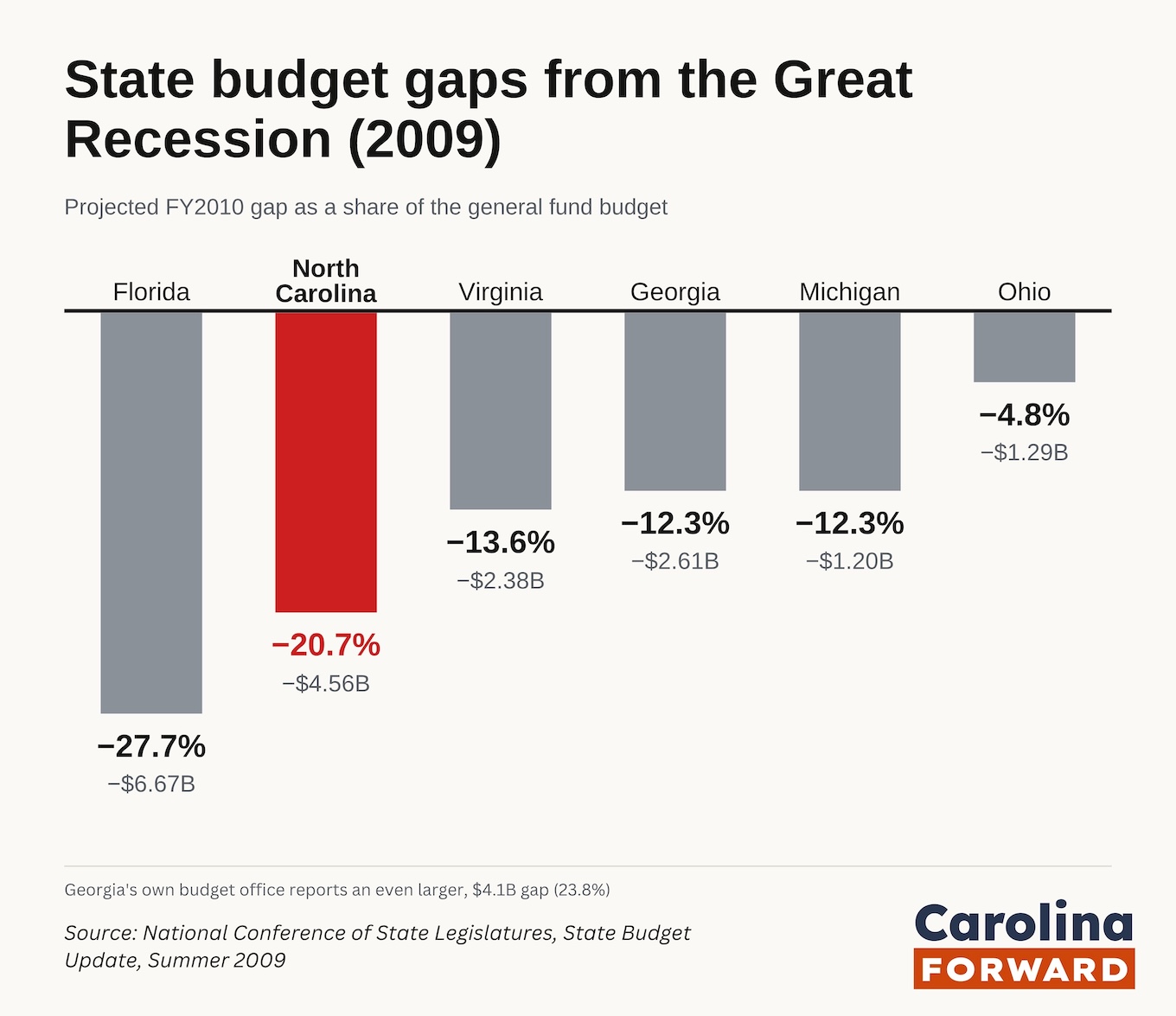
This is exactly what happened in virtually every state in the nation between 2008-2010 - including in North Carolina. In late 2008, the state’s Fiscal Research Division (FRD) had warned of a massive, looming tax revenue gap. By January 2009, the FRD officially showed a worsening situation: a $2 billion budget chasm, or approximately 10% of the entire state budget. By March, the gap had grown to $2.2 billion. Conditions kept deteriorating, however, and by the end of the FY2008-09 fiscal year, the full budget deficit sat at a staggering $3.2 billion, with an even larger, $4.6 billion shortfall projected for FY2009-10, representing roughly 20% of the state’s entire budget.
Revenues had indeed plummeted while costs rose.
In their executive capacities, first Governor Mike Easley in 2008, and then Governor Bev Perdue in 2009, responded first. Both governors issued a flurry of executive orders slashing budgets and drawing on state reserves to manage the immediate shortfall, while the legislature worked on a long-term budget. These cuts were painful ones many people still remember: a 2% cut to public schools, 6% from the UNC system, and deep state employee furloughs. Yet even these drastic measures were still not nearly enough.
The situation North Carolina’s lawmakers grappled with were similar to those in almost all other states. A massive, generational recession’s economic fallout wrecked well-laid budget plans in states large and small.
The Solution: Cuts, Taxes, and a Bailout
What ultimately balanced North Carolina’s budget was a combination of multiple cost-cutting and revenue-generating steps - plus significant federal recovery funds.
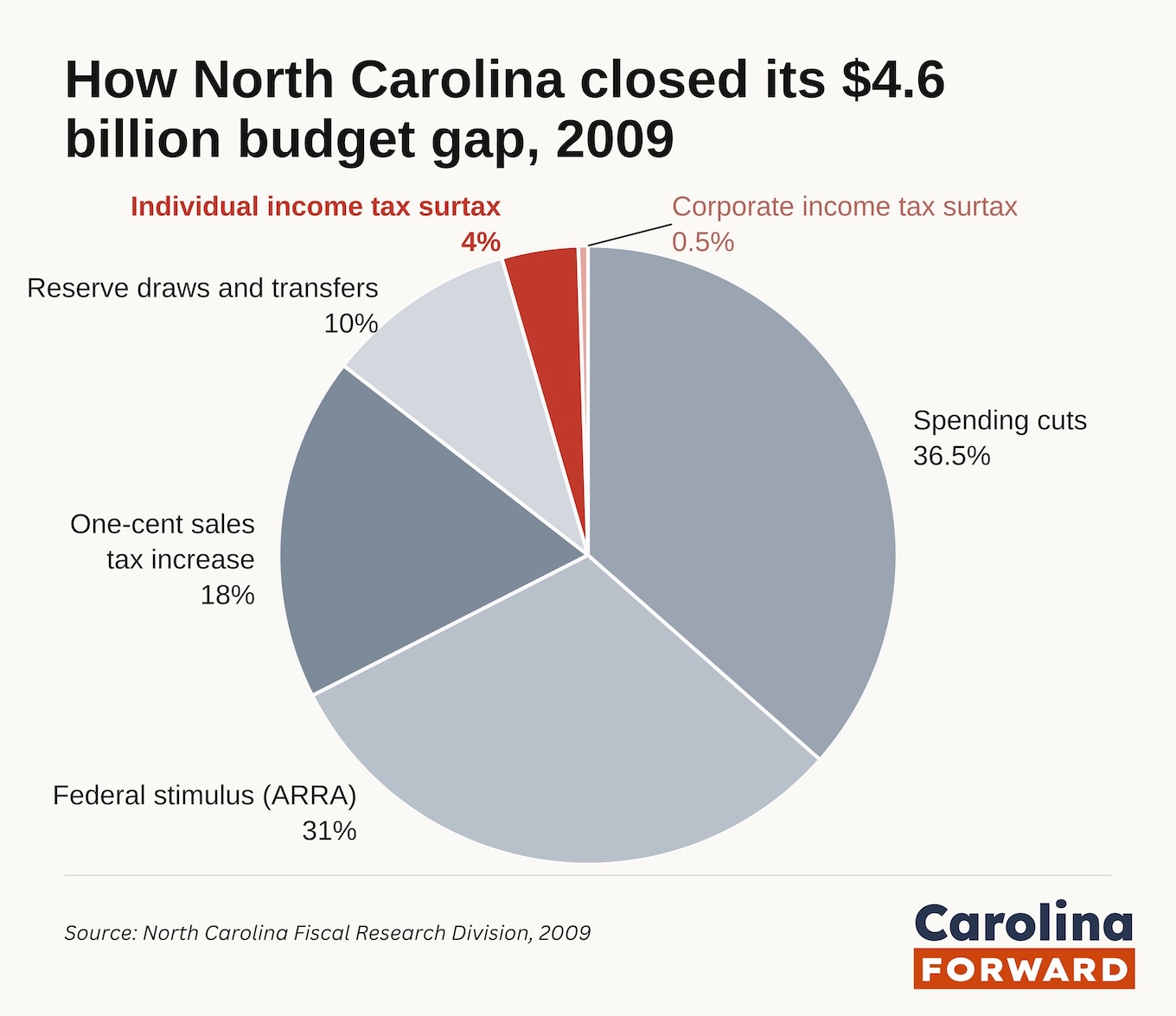
The biggest single deficit reduction measure was deep spending cuts. By laying off thousands of state employees, increasing the size of school classrooms, closing 7 state prisons, and slashing the state Medicaid system, lawmakers were able to close a bit more than a third of the deficit.
The federal government’s American Recovery and Reinvestment Act of 2009, signed into law by President Barack Obama, was a major economic stimulus package that saved nearly every state - including North Carolina - from dire fiscal collapse. This provided a bit less than a third of the budget support.
Around a quarter of the deficit was closed by raising revenue through taxes. Lawmakers instituted a one-cent increase to the state sales tax, which phased out automatically in 2011.
They also imposed a small income tax surcharge of 2-3% on the highest earners in the state. An important nuance is that this was not a simple addition to the tax rate; in stead, it was a surcharge on tax owed. What that meant was for earners in the highest bracket ($150,000 for single earners, or $250,000 for married couples filing jointly; in 2026 dollars, this would be equivalent to about $230,000 and $390,000, respectively), they owed an additional 3 cents on each dollar they paid in tax. The income tax surcharge also phased out automatically after 2010.
Along with a surcharge on the state corporate income tax and tapping state reserves, North Carolina was just able to survive the Great Recession’s fiscal carnage - but it took literally every tool at lawmakers’ disposal.
How would an income tax cap have changed the math?
This leads to a necessary counterfactual: what if North Carolina’s lawmakers in 2009 had been unable to tap the personal income tax, as today’s proposed constitutional amendment would do?
Had North Carolina lawmakers in 2009 been unable to raise a small amount of revenue from the state’s highest earners, they would’ve had to make up the shortfall with something else. They might’ve increased the sales tax even more, found ways to make even deeper cuts in state services, or been even more dependent on the federal government.
In the political environment of 2009, the federal government was considered the budgetary backstop of last resort. Today, the situation is different. Not only is the U.S. government under a significant and worsening debt burden, but the political environment makes dependence on the federal government a dicier proposition. In the wake of Hurricane Helene, North Carolina has received substantially less in recovery assistance from the Trump administration than other states did in previous disasters, and Donald Trump himself has “joked” about withholding Helene aid if North Carolina does not elect Republicans.
Is it too cynical to hypothesize about the potential strings attached to a future federal government bailout, like the ARRA? Or is it perfectly reasonable, for politicians on any side of the aisle, to be wary about tying their hands in the future in just such a predicament?
One thing is certain: recessions will happen again, and some of them will be bad ones. The proposal to tie North Carolina lawmakers’ hands in advance will cost the state dearly. As former Republican House Majority Leader Paul “Skip” Stam pointed out, it will likely hurt the state’s credit rating and encourage more borrowing. It will also encourage further reliance on regressive consumption taxes (like the state sales tax) which further penalize low-income people. North Carolinians would be wise to vote Against all three amendments.