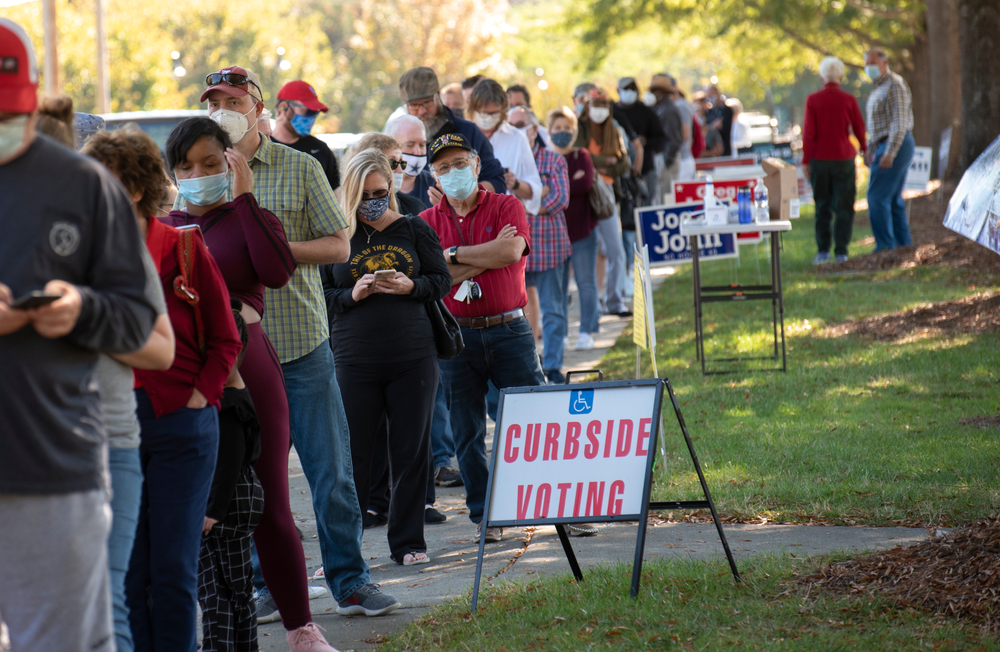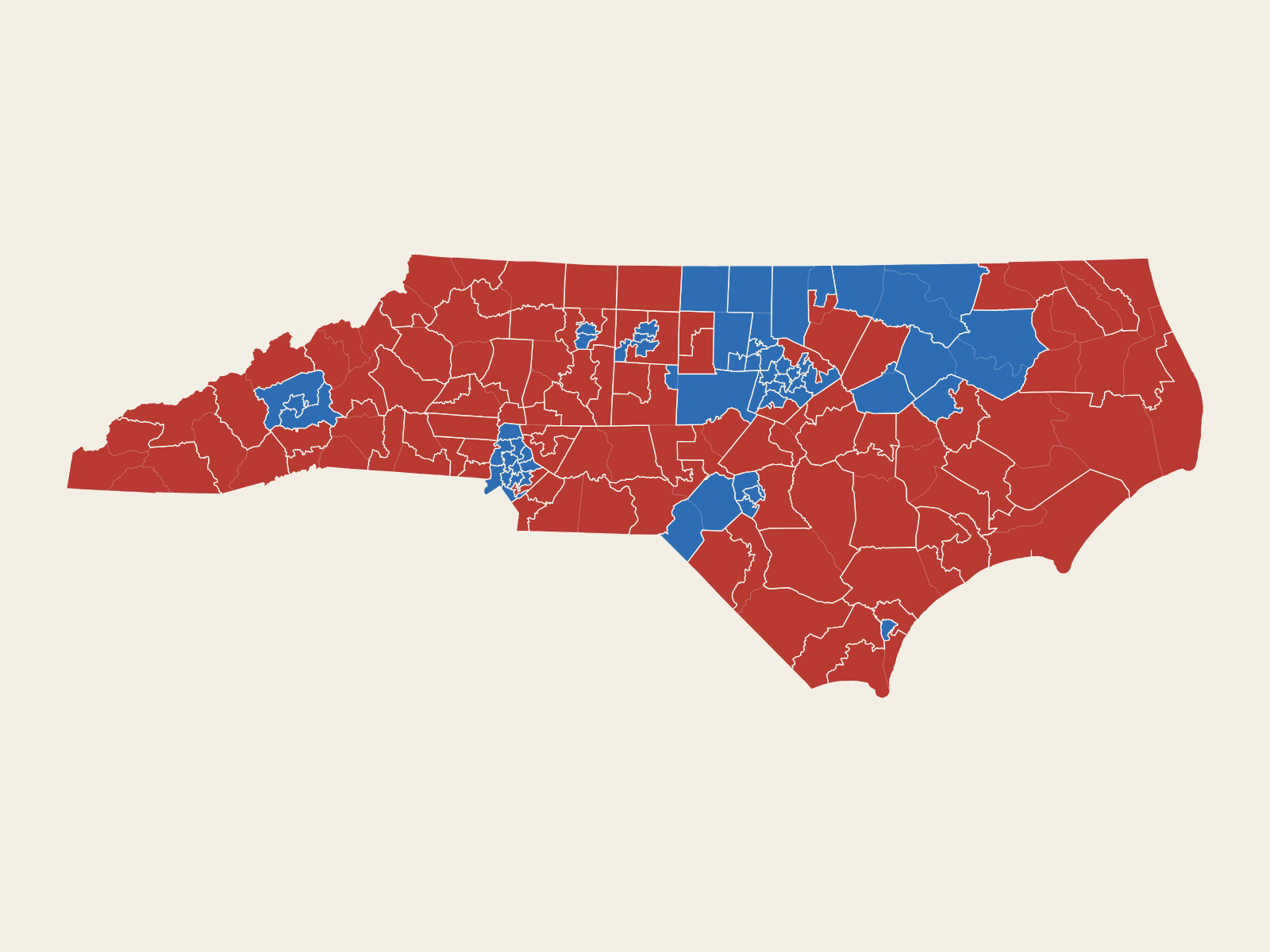
The 2026 midterm election has closed with a reverberating clap that will change the state for decades to come.
Last night, the voters of North Carolina made a thunderous and unambiguous roar for change, both in Raleigh and Washington D.C. Though polling has consistently suggested that North Carolina, like the nation as a whole, was facing a “blue wave” election, the results of the 2026 midterm election were much more of a blue tsunami.
Record disapproval with Donald Trump’s Presidency, the war in Iran, persistently high consumer prices and endemic political corruption in Raleigh and the Trump administration drove record voter turnout and extremely strong support for Democratic challengers. The Democrats blew past even the most optimistic expectations, capturing not only all statewide races on the 2026 ballot, but perhaps clinching supermajority control of the State House by flipping 24 seats. 1 Independent candidate also flipped a seat from a Republican incumbent.
Democrats flipped 4 seats in the State Senate, landing at 24 seats overall - 1 short of tying the chamber.
Across the state, Republican turnout was weak and consistently far below previous midterms in 2022 and 2018. Unaffiliated voters, a plurality of all voters in the state, disproportionately broke towards Democrats, handing them victories up and down the ballot.
US Senate
As long predicted, North Carolina voters elected former Governor Roy Cooper to be their next U.S. Senator, replacing current Senator Thom Tillis. What no one predicted was just how dominant Cooper would be. His final margin over Whatley was 19.7 points - the biggest margin for a North Carolina federal statewide candidate since 1974.
Senator-elect Roy Cooper commanded the campaign from the very beginning, leading his challenger, former RNC Chairman Michael Whatley, in every single recorded poll. The Senate race was never particularly close, and last polled within the margin of error in August of 2025, according to RealClearPolling.
The Whatley camp relied on an intensely negative campaign of personal attacks on former governor Cooper, hoping to change how voters viewed the winningest North Carolina political figure since Jim Hunt. Not only did the Whatley campaign’s strategy fail, but voters evidently found thought worse of him for it. The October edition of the Carolina Forward Poll not only found Cooper with a 10-point lead, but also holding a net-positive approval rating. By comparison, Michael Whatley ended his campaign with a dismal net approval of (-19) - an ignominious end to his political career.
Congressional
Democrats flipped 6 GOP-held Congressional seats. Republican Reps. Virginia Foxx (NC-5), Addison McDowell (NC-6), Richard Hudson (NC-9), Brad Knott (NC-13) and Tim Moore (NC-14), plus the GOP-held open seat in NC-11, all lost to their Democratic challengers. In NC-1, Democratic Rep. Don Davis held on to his seat despite an attempt by NC Senate Leader Phil Berger to gerrymander him out.
These included some head-spinning defeats: Richard Hudson currently chairs the National Republican Congressional Committee, and Tim Moore is the former longtime Speaker of the NC House, who essentially drew his own district while Speaker.
North Carolina’s Congressional delegation will now change to 10D-4R.
NC General Assembly
In a stunning performance, Democrats surged to clinch majority control of the North Carolina State House for the first time in 15 years, flipping 24 Republican-held seats to hold 71 in all (49 held by the GOP), with 1 GOP-held seat flipped by an Independent.
Democrats also flipped 4 seats in the State Senate, claiming 24 in all. In 2027, Republicans will hold only a bare 1-seat majority in the State Senate.
Under North Carolina’s Republican-drawn partisan gerrymander, this is a staggering result. Majority control of either chamber is expressly designed be all but impossible for Democrats win. In 2024, Democrats won outright majorities of votes statewide for both chambers, and yet Republicans still won a supermajority of seats in the State Senate, and were just 1 seat away from a supermajority in the State House. Election districts in both chambers are drawn to dilute and suppress Democratic voters to protect Republican majorities.
Voter anger was nevertheless intense enough to overcome even these firewalls, and give Democrats the over-performance required to win seats even in seats designed to defeat them.
Judiciary
Incumbent Democratic Supreme Court Justice Anita Earls cruised to victory in her re-election race, comfortably defeating her Republican challenger, Sarah Stevens by 17 points. In the three statewide races for the Court of Appeals, all three Democratic judicial candidates triumphed over their Republican challengers. Two of them, Judges John Arrowood and Toby Hampson, are incumbents; the third, Judge Christine Walczyk, is currently a District Court judge who will now join the Court of Appeals.
The NC Supreme Court race was seen as one of the most important of the cycle, because party control of the court will ultimately decide the long-term fate of partisan gerrymandering in North Carolina. The Republican-majority court has consistently protected the Republican legislature’s partisan gerrymanders of North Carolina’s Congressional and state legislative maps. Justice Earls’ victory will keep the court’s partisan balance at 5 Republicans, 2 Democrats, so little will change in the immediate future.
But in the 2028, 3 more seats are up for re-election, all currently held by Republican justices. Earls’ victory means that Democrats must win just 2 of those to flip party control of the court, which would spell the end of partisan gerrymandering in the state.
Local races
The Democratic wave did not stop at the statewide races. Democrats won and flipped many dozens of seats for local races all across the state:
- In New Hanover county, Democrats flipped control of both the county board of commissioners and the county school board
- In Forsyth county, Marcie West’s victory flipped control of the county board of commissioners to the Democrats. Democratic challenger Amara Hunter defeated 16-year Republican incumbent Jim O’Neil for District Attorney, spelling a stunning end for a perennial Republican candidate for statewide office.
- In Cabarrus county, Democrats won two seats on the county board of commissioners, breaking a 36-year streak of one-party Republican rule on the board.
- In both Lee and Jackson counties, Democrats flipped control of the county board of commissioners
- In Alamance county, Democrats flipped control of the county board of commissioners, the county school board and its District Attorney
Even more remarkable seat flips occurred elsewhere, but these were the biggest changes in the balance of power in communities all over the state.
What it all means
The 2026 election exceeded other “waves” like 2018 and 2010 in size and magnitude. One must go all the way back to 1994 to find an electoral shock that even remotely compares. Voters across the political spectrum registered their disgust at the political regime that currently controls Congress and the North Carolina State Legislature, and made a clear demand for change. Today is a new dawn for North Carolina’s politics.