President Donald Trump and Congressional Republicans slashed funding for Medicaid and the Supplemental Nutrition Assistance Program (SNAP, formerly known as food stamps) to pay for millionaire and billionaire tax cuts, and it’s hard not to see those choices as a deliberate attempt to exacerbate both poverty and income inequality. Even though these cuts to social services still won’t pay for the trillions added to the deficit by Trump’s high-income handouts, they will eviscerate programs many members of our communities rely on and likely increase inflation.
High-Income Handouts
There is a lot to be said about the 2017 tax cuts signed into law by the first Trump Administration. One effect they had was to significantly increase the federal budget deficit, making Trump’s first presidency the most expensive in American history.
While corporations got a permanent reduction in their tax rates, the working class did not. Most of the Trump tax cuts from 2017 were not permanent.
Now, Republicans extended their past cuts, keeping the tax breaks for corporations and the wealthy. To do so, they cut Medicaid and SNAP Benefits for the poorest Americans.
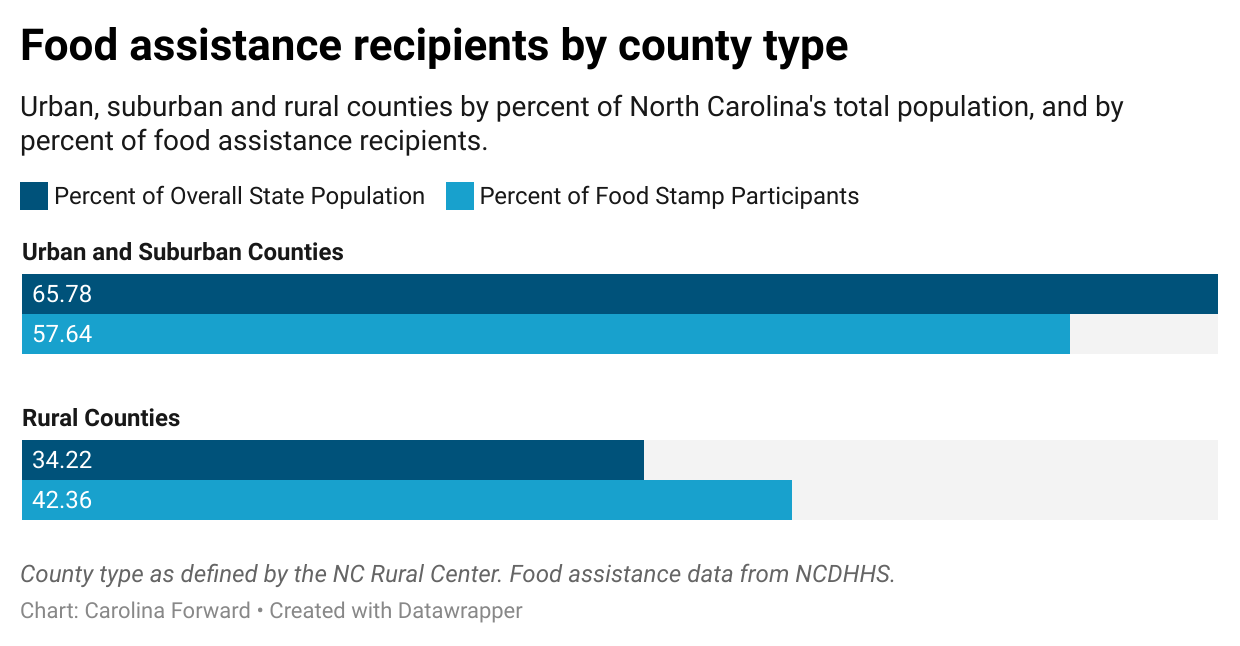
We’ve covered the attempt to cut Medicaid funding, which would particularly hurt rural North Carolinians; these SNAP cuts will do similar damage, hurting over a million North Carolinians’ ability to afford healthy food. Currently, 1 in 8 North Carolinians rely on SNAP benefits to put food on the table. In a state where more than 1.5 million people are facing hunger, SNAP is a vital lifeline. Those benefits disproportionately go to our long-undersupported rural counties.
SNAP is important to North Carolina’s economy as well, for both the labor market and agriculture. SNAP benefits are regularly praised as “one of the most effective and efficient supports for the economy during downturns, measured on a ‘bang-for-the-buck’ basis,” returning 1.50 in GDP for every dollar put in. This is because when people spend money, that spending becomes income for somebody else, and the cycle repeats. Since SNAP benefits are spent quickly – people who need food tend to buy food when you give them money to get food – they get this multiplicative effect.
SNAP may also help with educational attainment. Hungry students perform significantly worse in school, but 19% of children live in food-insecure households. A study in the journal Pediatrics found “food insecurity uniquely affects child health,” and the Annie E. Casey Foundation notes, “if food insufficiency occurs during the critical development window from adolescence until around age 24, it can have detrimental consequences.”
On the bright side, a 2017 study indicated “SNAP may be contributing to grade retention among children living in poverty, which can have positive lifelong consequences.” If legislators are serious about improving educational attainment, solving the child hunger crisis should be a greater priority than another high-income handout: private school vouchers.
SNAP Supports our Agricultural Economy
In addition to recipients getting crucial assistance to afford healthy meals, SNAP is an economic driver for North Carolina. The money quickly enters into the economy, boosting GDP, creating employment opportunities across sectors, and increasing state tax revenue. As the number one industry in the state, agriculture and agribusiness contributes $111.1 billion to the state’s economy, with the purchasing power of SNAP contributing to that sector. SNAP also increases state tax revenue, since at each step the state receives a small portion in sales taxes, and produces non-farm jobs as well, since at each step someone needs to be selling a good or service. When North Carolinians receive SNAP funding, the entire economy benefits.
In the face of all the good SNAP does, not even Republicans could justify an outright cut. Instead, they are shifting some of the funding burden to the states, and depending on a state’s payment error rate, that amount increases. Preliminary estimates showed that the house version of the bill could leave North Carolina with a $700 million funding shortfall, one that the North Carolina General Assembly is unlikely to try and make up.
SNAP cuts would be a disaster for North Carolina’s economy. Combined with Medicaid cuts, a conservative estimate from the Commonwealth Fund had North Carolina losing over $3.6 billion in GDP, $254 million in tax revenue, and 35,000 jobs. This estimate doesn’t include the effects on public health or school performance. All because congressional Republicans would rather have a tax cut than put food on the table of working North Carolina families.
Every House Republican from North Carolina voted for this bill. They voted to strip healthcare from some of our poorest neighbors and take food off their tables. The General Assembly can and should work to make up for these cuts, and we should remember what they did when they are back up for re-election.