Nearly 150,000 people moved to North Carolina last year. Only Texas and Florida grew more.
In response to high housing costs and unprecedented population growth, Governor Stein recently signed an executive order to increase housing affordability and opportunity across North Carolina, noting: “You’ve heard the saying, ‘if you build it, they will come.’ In North Carolina, we’ve seen that, if you don’t build it, they’ll come anyway.”
He’s right: people will keep coming, and our economy will keep growing as they do. We need to be sure that the benefits of that growth reach everyone. To do that, North Carolina needs to develop (and redevelop) in more affordable and more pleasant ways.
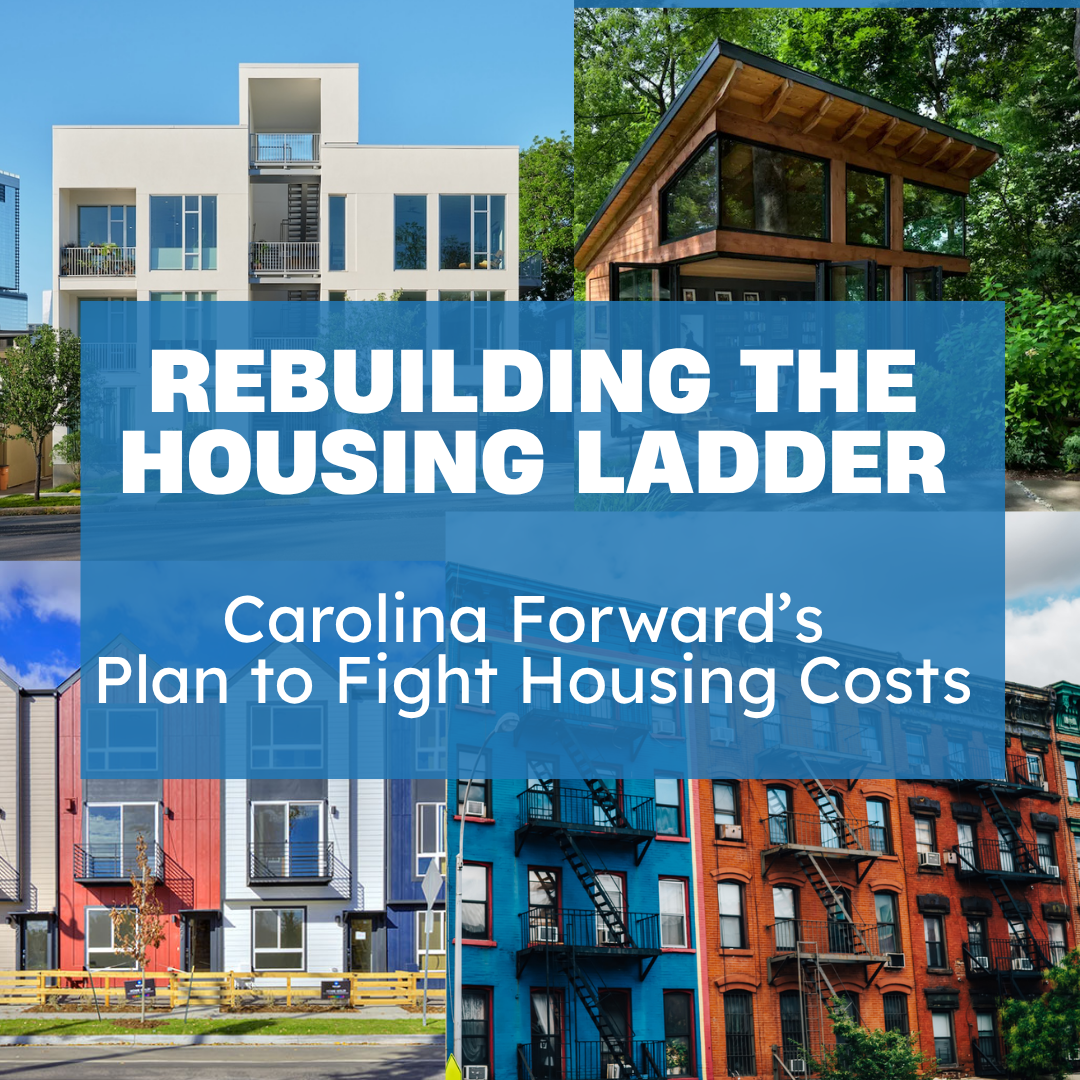
Carolina Forward’s new plan to Rebuild the Housing Ladder will increase housing opportunity and housing affordability. It identifies fiscally sustainable development patterns that will minimize the cost of public services, recreate a starter home market, and maximize opportunities for a healthy, connected lifestyle.
The plan has eight pillars:
- More ADUs and Tiny Homes
- More Townhomes and Historic Housing Types
- More Single-Stair Buildings
- More Housing in Commercial Zones
- Legalize Single Room Occupancy Residences
- No (or Low) Minimum Lot Sizes
- No Arbitrary Parking Requirements
- No Poison Pills
Individually, each of these reforms helps. Working in tandem, they can be transformative.
Restoring the Missing Rungs
Median prices and median rents have grown faster than incomes for decades. As housing prices grew, the variety of types of housing communities relied on decreased.
With development patterns constrained to sprawling single family neighborhoods and isolated, car-dependent apartment complexes, communities across the country created conditions that imposed a high cost of services on local governments, high land costs on homebuyers, and high transportation costs on workers. The lack of choices plus widespread opposition to new housing within existing city limits created artificial housing scarcity and fueled rising costs.
Creating more housing choices within reasonable urban services networks will maximize affordability, minimize the cost of services, and protect North Carolina’s natural beauty.
Some of the housing types we endorse in this framework are already making a comeback: cities that have encouraged more townhomes are creating new price ranges attainable to all sorts of homebuyers. Other options may be less familiar: single-stair buildings, for example, have largely vanished from new construction in America, as have the single-room occupancy residences that once created cheap but secure housing for low-income earners.
Some of our most important recommendations concern the poison pills that kill fiscally sustainable development. High minimum lot sizes impose high land costs on buyers and drive up the cost of infrastructure and services. Constricting limits on height, setbacks, and density lock out new supply and keep towns from creating fun, walkable streets with neighborhood retail.
You’ll find all these details and more inside our new plan. Check it out: https://carolinaforward.org/research/rebuilding-the-housing-ladder-in-nc/