Earlier this year, North Carolina’s automotive fleet crossed a major threshold. For the very first time, electric vehicles (EVs) accounted for roughly 1% of all active vehicle registrations in the state. If one includes plug-in hybrids along with pure EVs, the proportion is much higher (about 4.3%); while if one compares only pure EVs to old-fashioned internal combustion engine (eg. gas-fueled) cars, the proportion is just above 1%. Whichever comparison one uses, the conclusion is the same: electric vehicles have hit an inflection point in new auto sales in North Carolina, and consumers are adopting them in greater numbers every year.
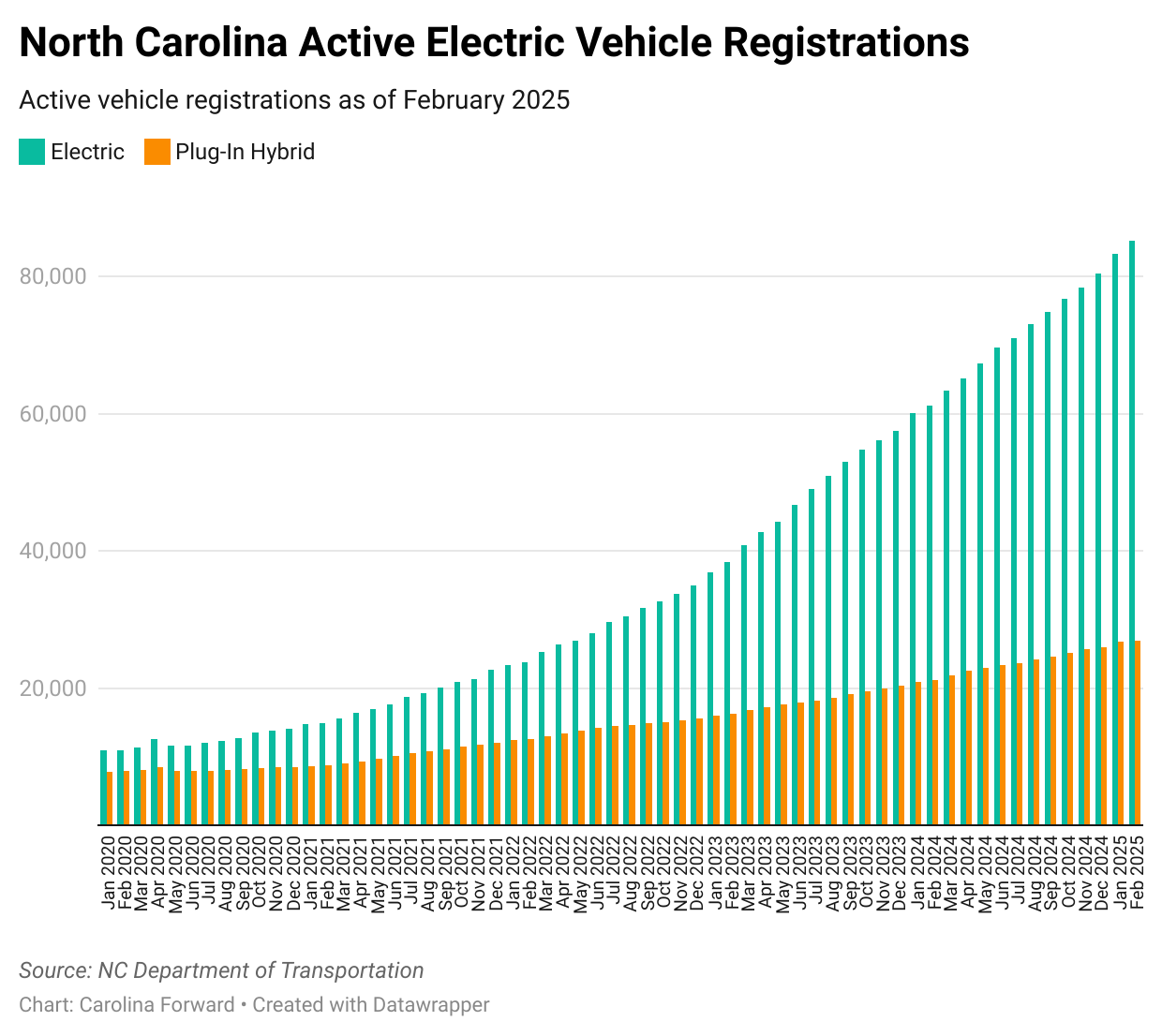
See all data for the chart above here, courtesy of the N.C. Department of Transportation.
There is broad consensus in the global automaker industry that demand for older gas-fueled cars (often referred to as ICE, for internal combustion engine, cars) has peaked, as global sales volumes of ICE vehicles bears out. In the United States, EVs accounted for 7.5% of all new car sales in Q1 2025 - another new high - and new EV sales are still growing by double-digits, while ICE car sales have remained stagnant. Globally, EVs have reached the stage of mass consumer adoption, which continues to accelerate the industry’s shift.
While ICE vehicles are still a large majority of the vehicle fleet, both here in North Carolina and across the country, the end of the road is now visible. ICE vehicles have peaked as a share of the automotive fleet and are steadily dropping every year.
EVs surging, while gas cars stagnate
According to vehicle registration data from the N.C. Department of Transportation, North Carolina added 239,790 new electric and plug-in hybrid vehicles to the road from 2020 through 2024. What’s more, the EV adoption curve has been steady, with new EV registrations virtually every single month measured. By contrast, only 121,665 new ICE vehicles, or roughly half as many, were added during that same period.
North Carolina drivers were already adopting EVs when the Biden-Harris administration, in 2022, introduced a new tax credit that made EV purchases more affordable through the Inflation Reduction Act (IRA). The IRA offered car buyers a $7,500 tax credit for purchases of new EVs and a $4,000 credit for purchases of used ones, subject to eligibility limits.
Registration figures make it clear that the IRA tax credits accelerated the EV adoption that was already underway: in the first half of 2022, before the EV tax credits went into effect (in August of that year), the NCDOT recorded 26,073 new EV registrations. In the first half of 2023, after going they went into effect, NCDOT recorded 32,684 new EV registrations. In the second half of 2024, NCDOT recorded 47,573 new EV registrations - as well as 11,892 ICE vehicle registrations that were discontinued entirely.
Even Governor Roy Cooper underestimated the untapped consumer demand for EVs. In 2018, the former Governor set a goal of having 80,000 “zero-emission vehicles” on the road by November of 2025, only for North Carolina to break his goal two years early. This mirrors the larger national shift away from ICE vehicles and towards electric ones. That shift positions North Carolina as a major beneficiary by landing new investments such as Toyota’s $14 billion battery manufacturing plant near Greensboro.
Give the people what they want
Among the many blows to North Carolina inflicted by the Trump administration’s “One, Big” budget is the termination of the EV tax credits that helped many people afford the purchase of an electric vehicle. The revocation of those tax credits, a major win by fossil fuel industry lobbyists, could slow the EV adoption curve somewhat. But consumer demand for EVs is so strong that they will do little but delay the inevitable. Electric vehicles are on the road to mass adoption not because of tax credits, but because American drivers enjoy not being shackled to expensive and unpredictable gas prices.