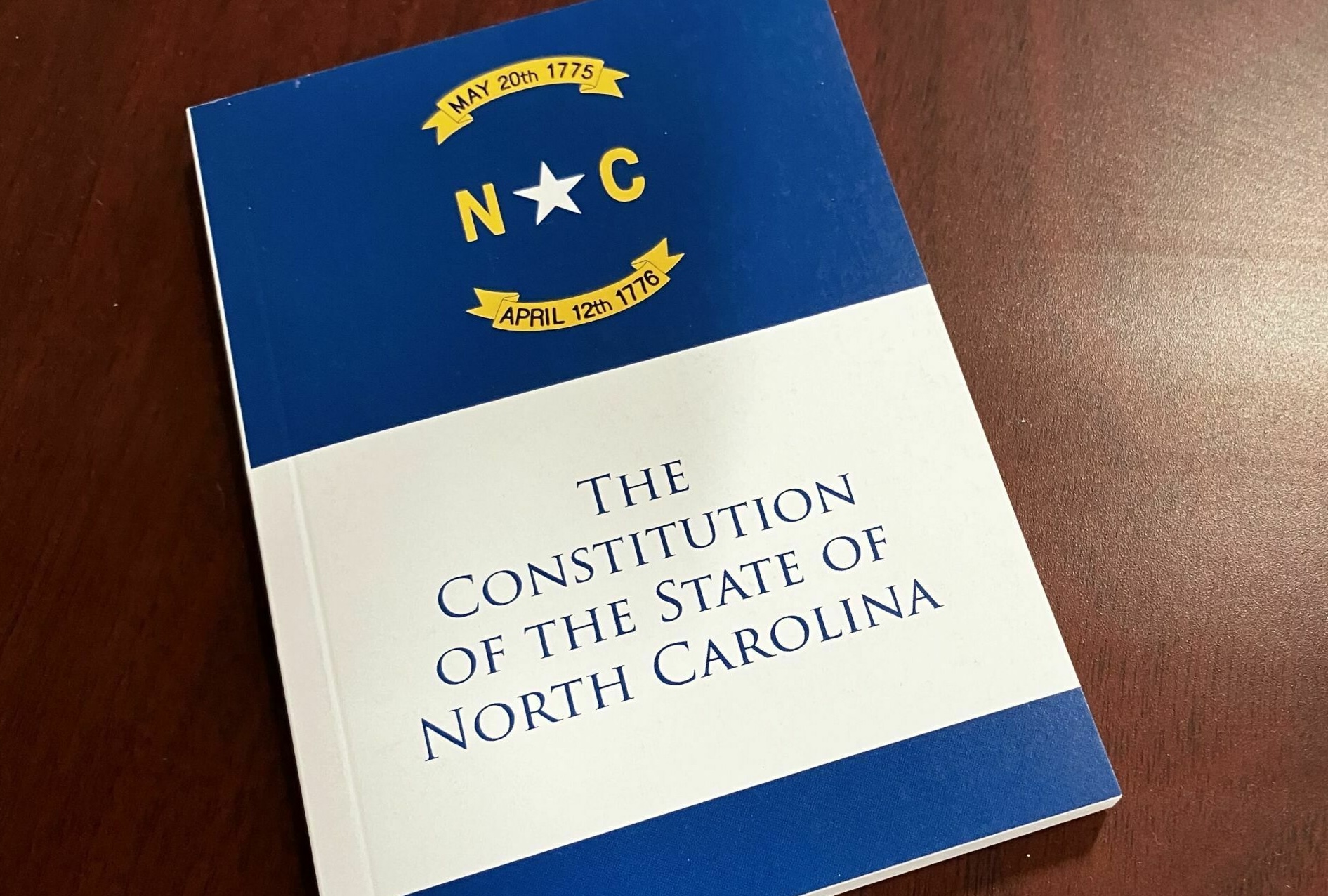
For nearly the last eleven years straight, North Carolina’s political leaders have been in court fighting one another over the meaning of our state constitution. In the most recent round, Governor Josh Stein is currently suing the Republican leaders of the state legislature who stripped his office of its appointment powers. Previously, Governor Cooper was famously in and out of court for most of his eight years in office over similar (and some identical) fights. Before him, even Governor Pat McCrory himself sued his fellow Republicans in the legislature over most of the same issues.
On the surface, these all appear to be differences over interpretations of the separation of powers. But in a larger sense, they are fundamental questions of how the voters’ will is to be put into practice, and into which offices it should flow. On these questions, North Carolina’s state constitution is cumbersome and often unclear enough that it invites some of the dysfunction we see today. To that end, a constitutional overhaul could greatly improve the quality of governance in North Carolina - though deeper fundamental problems remain.
While the practicalities of crafting a fourth constitution for the State of North Carolina may seem like an unrealistically daunting political lift in this day and age, imagining what one might look like can be instructive. Here are some ways a new state constitution could help improve North Carolina’s governance.
1: Unify the executive branch
While most people think of the executive branch of government as mostly consisting of the Governor, it’s actually much broader. North Carolina’s Council of State, with its 10 independently elected executive offices that each hold their own constitutional powers and authority, is unique in the nation - and also uniquely problematic.
By design, North Carolina governors are frequently unable to enact their policy, in lieu of Council of State members that many (if not most) voters are unaware even exist. A new constitution should significantly slim down this body.
In most U.S. states, positions like the Commissioners of Labor, Insurance and Agriculture, the State Superintendent of Public Instruction (or its equivalent) and the State Auditor are appointed by the Governor. For example, North Carolina is one of only 4 states in the entire nation with an elected Commissioner of Labor, and one of only 11 with an elected Commissioner of Insurance. Roles like these often call for specialized domain expertise to regulate or manage important state functions, and making them appointed by the state’s chief executive would be the logical extension of the voters’ will.
2: Reform the redistricting process
If the last thirty years of North Carolina political history make anything crystal clear, it is that our redistricting process is broken. Republicans who still hold a grudge about Democrats’ gerrymander of the 2001 legislative maps should logically support redistricting reform, as should Democrats who feel the same about the Republicans’ gerrymandering since 2011. No matter what party does it - and both parties’ hands are soiled - partisan gerrymandering makes a mockery of our representative democracy and distorts our politics.
There are many good independent redistricting commission plans around the country constitutional drafters could pick from. Michigan’s process is widely considered a national model for its built-in insulation from political influence, and would be a good basis for North Carolina’s own commission. While no system is perfect, almost any independent commission would be superior to the status quo. This process should be enshrined in North Carolina’s constitution to ensure that the General Assembly and our Congressional delegations were actually representative of the voters.
An even better step than hammering out an independent redistricting commission would be to end redistricting entirely by moving North Carolina to a system of proportional representation. Such a system, already in place in nearly every other representative democracy in the world, hands more power to voters and would also give third parties the realistic chance of representation they lack today. Short of full proportional representation, instituting ranked-choice voting would be another positive step.
3: Stagger Senate terms and limit time in leadership
Currently, all members of the General Assembly are up for re-election every 2 years. This is a healthy level of accountability to voters in the State House. But in the Senate, making terms 4 years, with only half the chamber facing re-election each cycle, could help make it a more functional body.
To that end, setting limits on the leadership of the General Assembly - specifically the House Speaker and Senate President Pro Tem - would inject much-needed dynamism and fresh thinking into the legislature, and help guard against the empire-building that our leaders now engage in.
Not all problems are constitutional
Of course, adjusting the structure of our governance through the state constitution can only do so much. Reforms like these would go a long way to help unclog North Carolina’s hardest political conflicts, but wouldn’t solve all of them. At the most fundamental level, what North Carolina needs is political leaders equally committed to a representative democratic governance in a constitutional system. We lack that today.
Indeed, there was remarkably little constitutional conflict in North Carolina for 40 years until the current Senate Leader Phil Berger and House Speaker Tim Moore came to power in 2011. It was these men (and, today, House Speaker Destin Hall), personally, who instigated one constitutional crisis after another with Governors McCrory, Cooper and now Stein by stretching, warping and occasionally breaking our state’s founding documents. Those are due to failures of personal integrity, not the state constitution.
This being the case, would an updated state constitution solve North Carolina’s political conflicts? The answer, of course, is no. Leaders who are hell-bent on bending the law for their own personal power will find ways to distort any document. But a clearer state constitution could help strengthen our state’s form of government against future manipulation.