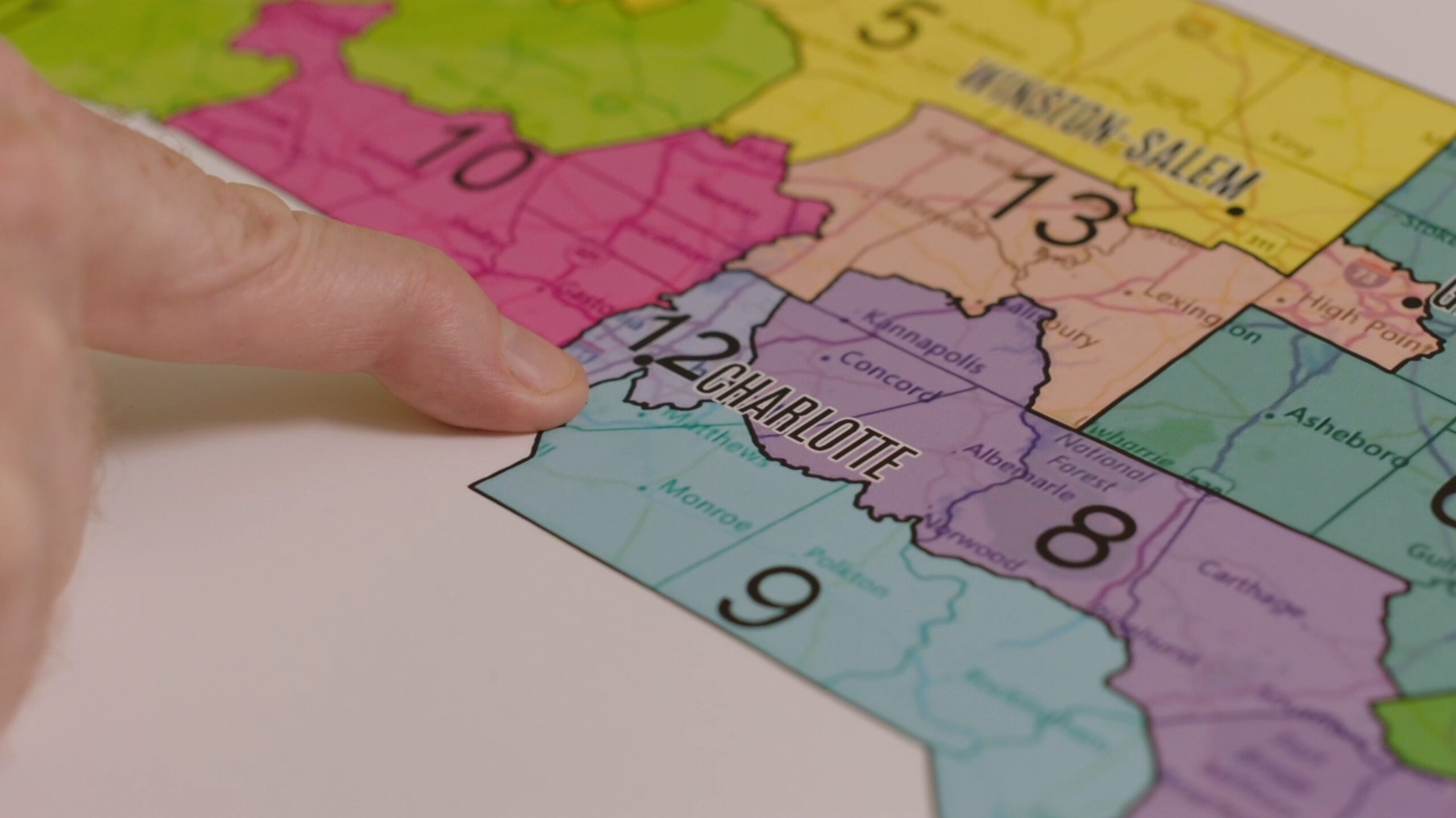
Last week, North Carolina’s Republican leaders announced an unprecedented and discretionary mid-decade redistricting of the state’s Congressional map. Though our state’s 2023 Congressional map was already an egregious partisan gerrymander, its 2025 successor is a farce. This year, Republican map drawers dispensed with even the usual pretense of impartiality. Republican State Senator Ralph Hise was characteristically unsubtle: “The motivation behind this redraw is simple and singular: drawing new map that will bring an additional Republican seat to the North Carolina congressional delegation.”
The United States is barreling headlong into a Constitutional crisis that jeopardizes the basic legitimacy of American elections. This crisis was instigated by Donald Trump, whose orders to Republican state legislatures to redraw their districts in a way more favorable to him kicked off a national chain reaction. Republican and Democratic-led state legislatures are now attempting to balance each other out, each citing the other’s maps as justification.
For those of us dedicated to the core American principle of representative government, these are dark times. But pessimism is not sufficient for the moment. A constructive alternative is not only possible, but readily available: instead of partisan map-rigging, North Carolina and other states should adopt an independent redistricting commission system without delay.
The “Zero-Trust” Approach to Redistricting
In the information security field, “zero trust” is a framework for designing highly secure systems. It means what it says: it assumes “zero trust” between all parties in a transaction or communication. This is a useful starting point in solving the redistricting issue, because a basic reality of American politics today is that trust - that basic human ingredient which, in various ways, makes so many basic interactions possible - is gone. Neither Democratic nor Republican partisans will ever trust the other to draw “fair” districts.
For cynics, this is where the discussion ends. All politics is power politics, they say, and attempting to construct guardrails is naive.
Here at Carolina Forward, we disagree. There is a principled way to design a redistricting system that protects the legitimacy of our electoral system while relying as little as possible on trust between political actors. It is a proven system that has delivered election maps broadly considered fair - and, perhaps positively, not particularly liked - by both the left and right. And it was invented just a few hundred miles away, up in Michigan.
As Independent as Redistricting Gets
In 2018, voters of Michigan approved Proposal 2, a ballot initiative to create an independent redistricting commission unlike any other tried in America. The proposal passed by a whopping 23-point margin, with deep bipartisan appeal (though the Michigan Republican Party tried and failed to block it in court). The proposal created the Michigan Independent Citizens Redistricting Commission (MICRC), with specific rules for how the commission would select its members.
The MICRC has 13 members. By law, 4 are Republican, 4 are Democratic, and 5 are unaffiliated with either party. The Michigan Secretary of State randomly selects these members from a pool of over 200 candidates, who themselves are chosen after more than 10,000 applications are randomly sent to voters across the state. Partisan officials, candidates, their family and close associates are barred from participating. Both the majority and minority leaders of the state legislature are allowed to strike (but not add) up to 5 applicants each. Out of the remaining pool of 180 candidates, the Secretary of State randomly selects the 13 members with the breakdown above.
In each case, randomness is ensured by public drawings which are audited by an independent third party. The Secretary of State plays a completely administrative role, not a discretionary one, and thus does not do any “choosing” of any candidate or another.
Districts drawn by the commission cannot be blocked by the state legislature. Its members and staff are not appointed by the legislature. In these ways, Michigan’s commission is thus most independent such body in the country by virtually any measure.
After selecting members, the MICRC follows a 7-step plan to draw districts, involving public hearings, consideration of compactness and contiguousness, and no consideration of incumbency.
The result of Michigan’s system has been enviable. Both parties have agreed that the state’s districts are competitive and fair, and quantitative analysis confirms the same.
Partisan gerrymandering is not inevitable
In today’s hyper-polarized climate, it often feels as if there are fewer and fewer people who still cling to basic first principles on any issue with high partisan valence like redistricting. Doing so may even appear precious or quaint. Yet if holding fast to principle was easy, it would be more common. It is far easier, to be sure, to slouch back into the lazy and deep partisan grooves that define so much of modern politics - as many have on this particular issue.
For the boldly principled, John Rawls’ veil of ignorance is a useful mental model for approaching the question of how to draw districts to represent the will of the voters. In the bluntest terms, what redistricting system would you have your ideological opponents use against you? Though “zero trust” is an uninspiring motto, it is likely the most realistic basis on which to approach this question in today’s day and age.
To be sure, Michigan’s commission is not perfect, and has its flaws. No system designed by humans can be perfect. As we wrote in Our Indivisible Destiny, our policy paper on democratic reform, a move to full proportional representation would likely be a superior system to districting altogether. Yet that is a much more ambitious project.
We reject the proposal from some that North Carolinians - and Americans as a whole - must just accept gross partisan corruption and cheating as a substitute for representative elections. North Carolina, and other states, should embrace independent redistricting modeled on Michigan’s system, as proposed in House Bill 20, the Fair Maps Act proposed in this year’s legislature. It is the right thing to do now, and for future generations of our state. Democrats, Republicans, independents and otherwise owe this much to ourselves and our beloved home.