As America barrels into a turbulent election year, North Carolina voters are on track for another closely contested, yet potentially pivotal, election year. The January edition of the Carolina Forward Poll finds North Carolina’s voters once again narrowly divided not only about candidates for office, but about the future direction of the state and nation.
Will Roy Cooper break the streak?
North Carolina’s Democrats have not won a statewide federal election in 18 years. Ever since former President Barack Obama and the late Senator Kay Hagan’s wins in 2008, Republicans have won every statewide election since for U.S. Senate and the Presidency. This continues a long tradition of partisan ticket-splitting between state-level and federal races in North Carolina that reaches all the way back into the 1970s.
Yet it appears that former Governor Roy Cooper could very well break that losing streak in 2026. Roy Cooper holds a 5-point lead over his presumptive Republican opponent, Michael Whatley.
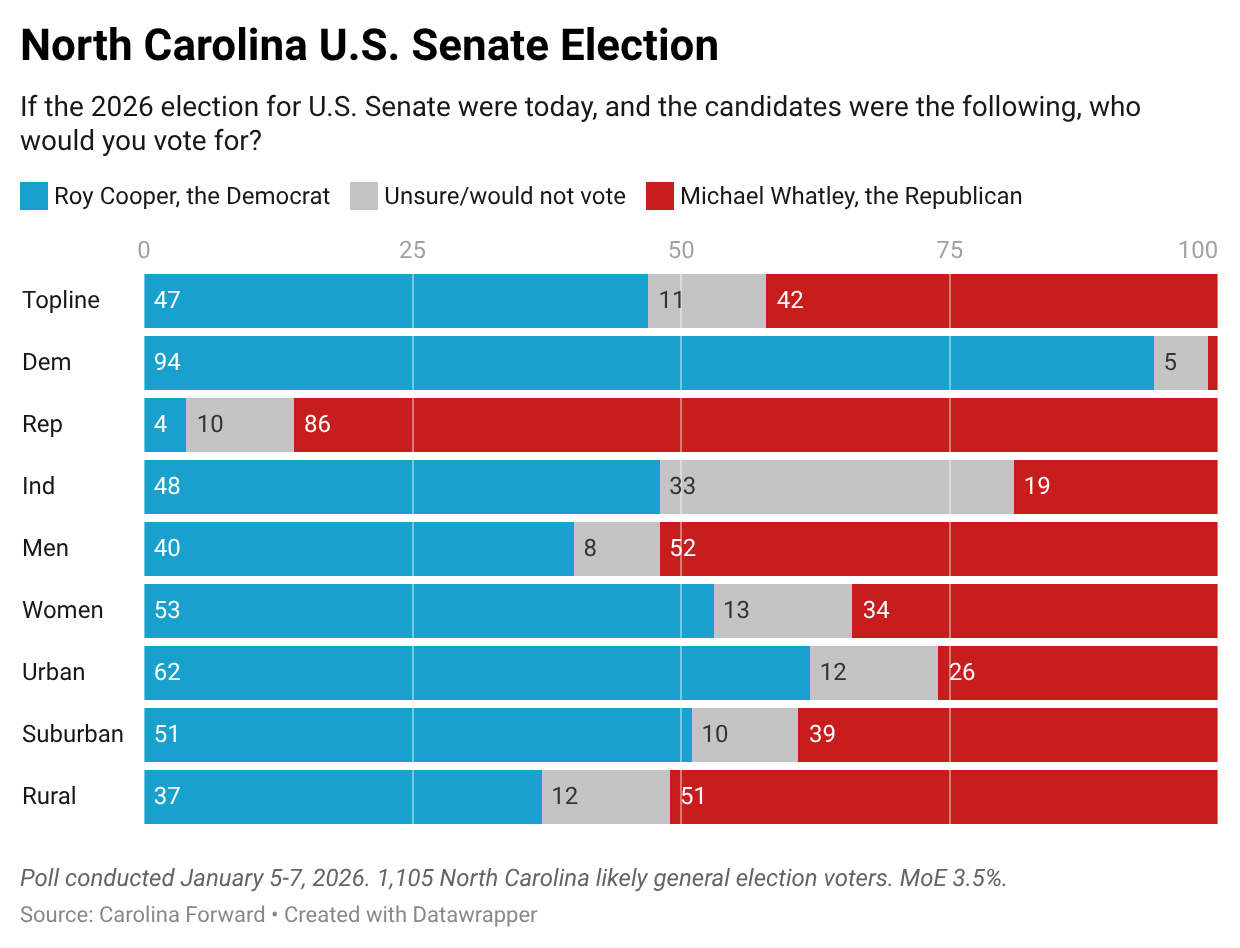
This represents a slight dip since the September Carolina Forward Poll, where Cooper held a 7-point lead. Yet that slight narrowing appears mainly attributable to consolidation among Republican voters. The poll shows that former Governor Cooper is gaining among Independent voters. Unless we see a significant reversal, Cooper remains the favorite to be the first Democratic candidate to win a statewide federal race since 2008.
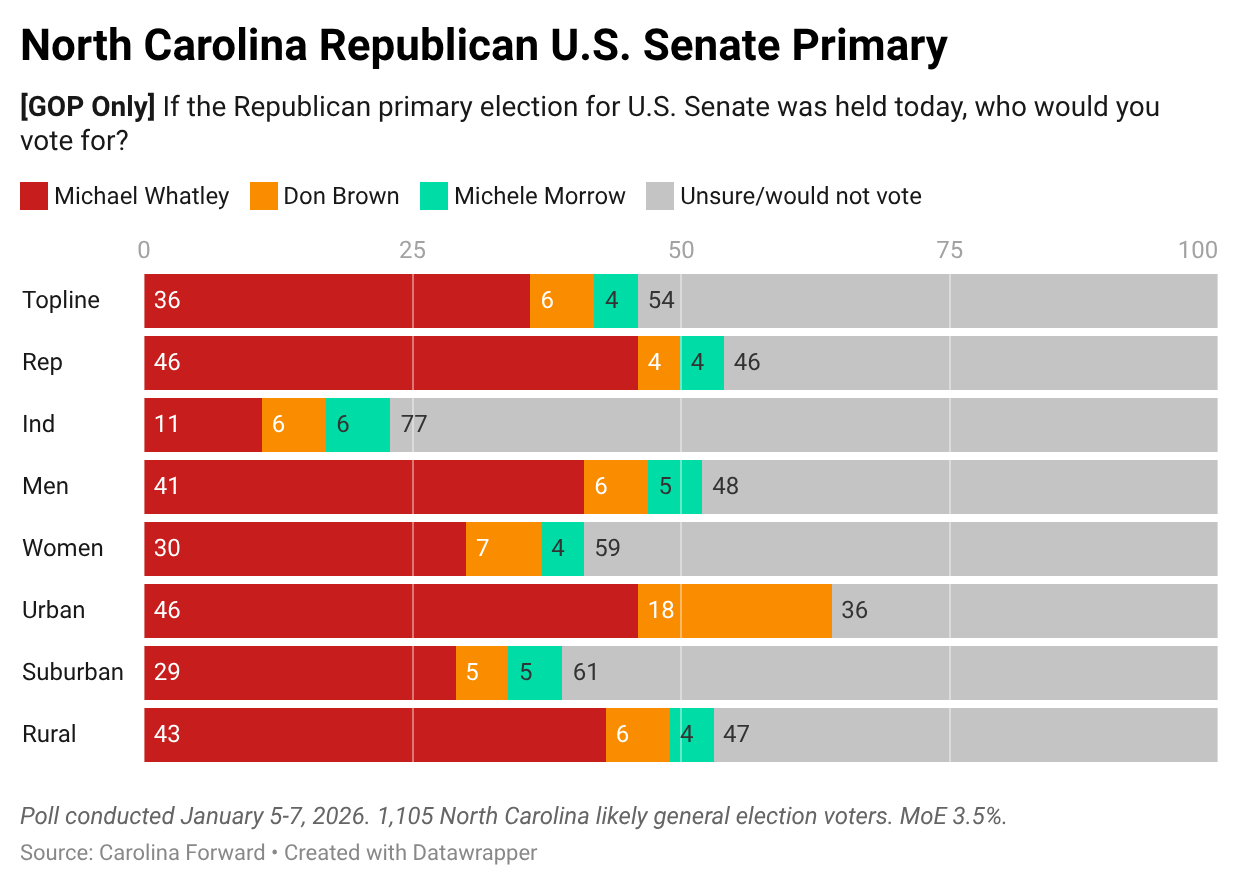
Michael Whatley remains the presumptive Republican nominee for the U.S. Senate. Even after months of campaigning by candidate Don Brown and a splashy entrance by the ever-peculiar Michele Morrow, neither candidate has managed to crack double digits among Republican primary voters. Even though Whatley himself has still not won over a majority of Republican primary voters, neither of his declared rivals appears to be a legitimate challenge. As the Republican establishment’s preferred option, Michael Whatley will almost assuredly be the Republican candidate in November.
Turning to the North Carolina State legislature, the generic ballot has tightened. Voters are equally split about whether they’d pick the Republican or Democratic candidate for their representative in Raleigh:
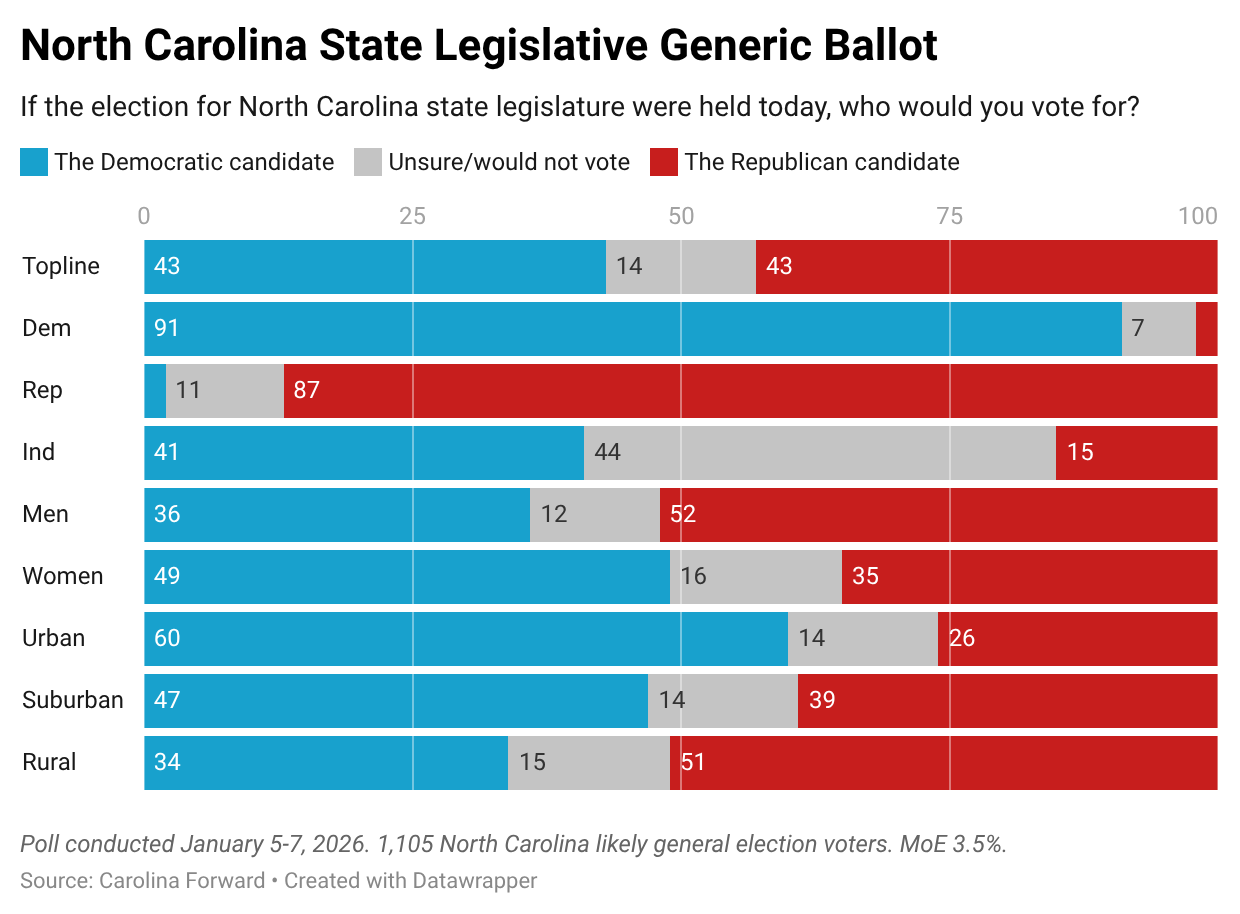
Similarly to the U.S. Senate ballot, this tightening mostly reflects consolidation among Republican voters and some movement among Democrats within the margin of error. This poll shows a 17-point net swing towards Democrats among Independent voters since the September poll.
One of the highest-profile races in North Carolina this year will be for the state’s Supreme Court. Democratic incumbent Justice Anita Earls is defending her seat against Republican State House Representative Sarah Stevens. The poll shows the two effectively tied, with Stevens holding a 1-point lead over Earls.
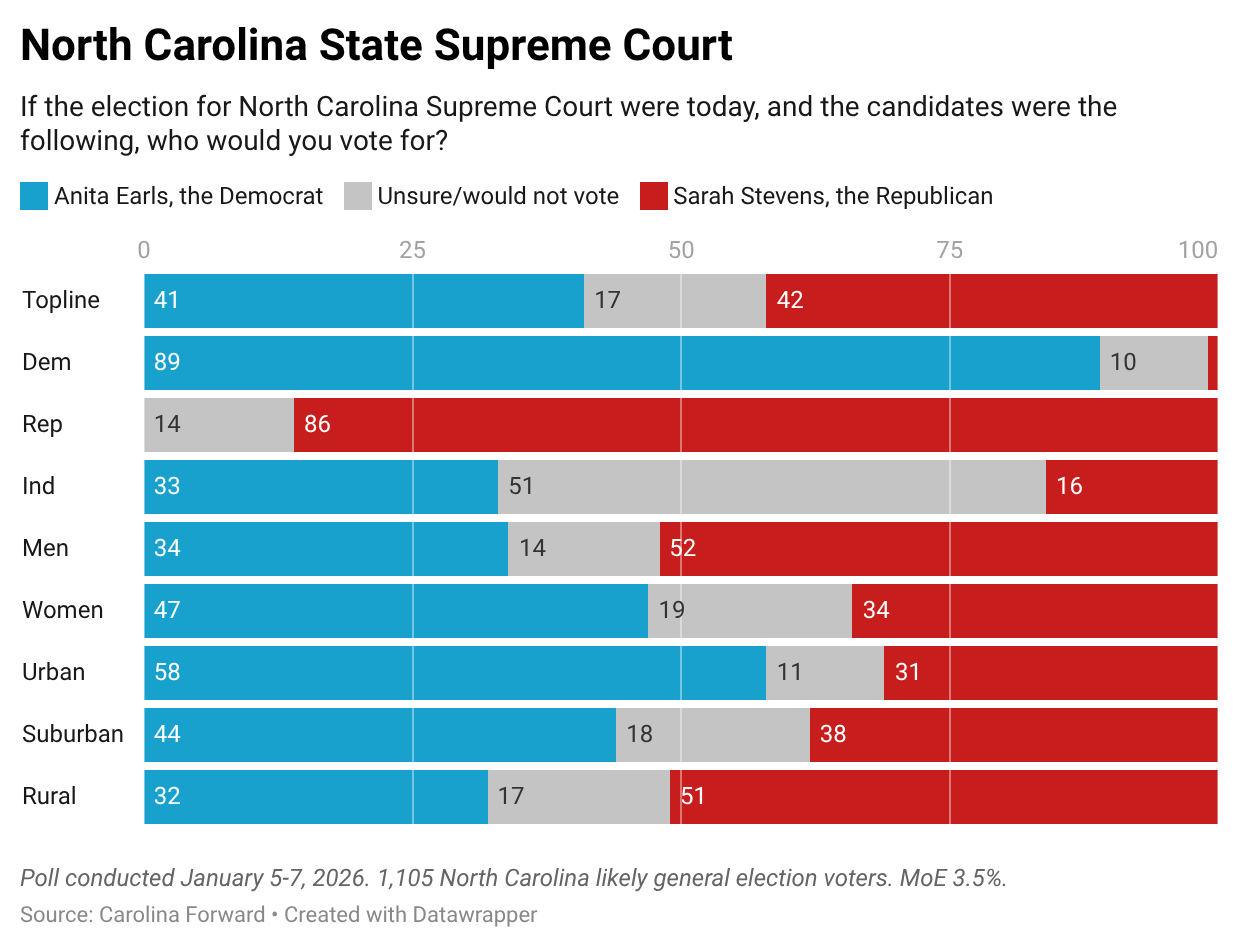
The breakdowns in support are almost identical to the generic ballot, suggesting that the Supreme Court race is still very low-visibility. Most voters have not heard much, or anything, about it.
One of the biggest developments across the United States in the Trump era has been aggressive, militarized anti-immigration crackdowns. Back in November, North Carolina itself saw this close up with ICE’s “Operation Charlotte’s Web” exercise, which focused but was not limited to Charlotte and Raleigh metro areas. In the January poll, we asked voters to indicate their view on the operation. A clear majority was negative, with a plurality saying they thought the ICE crackdown mistreated people and targeted people for their skin color.
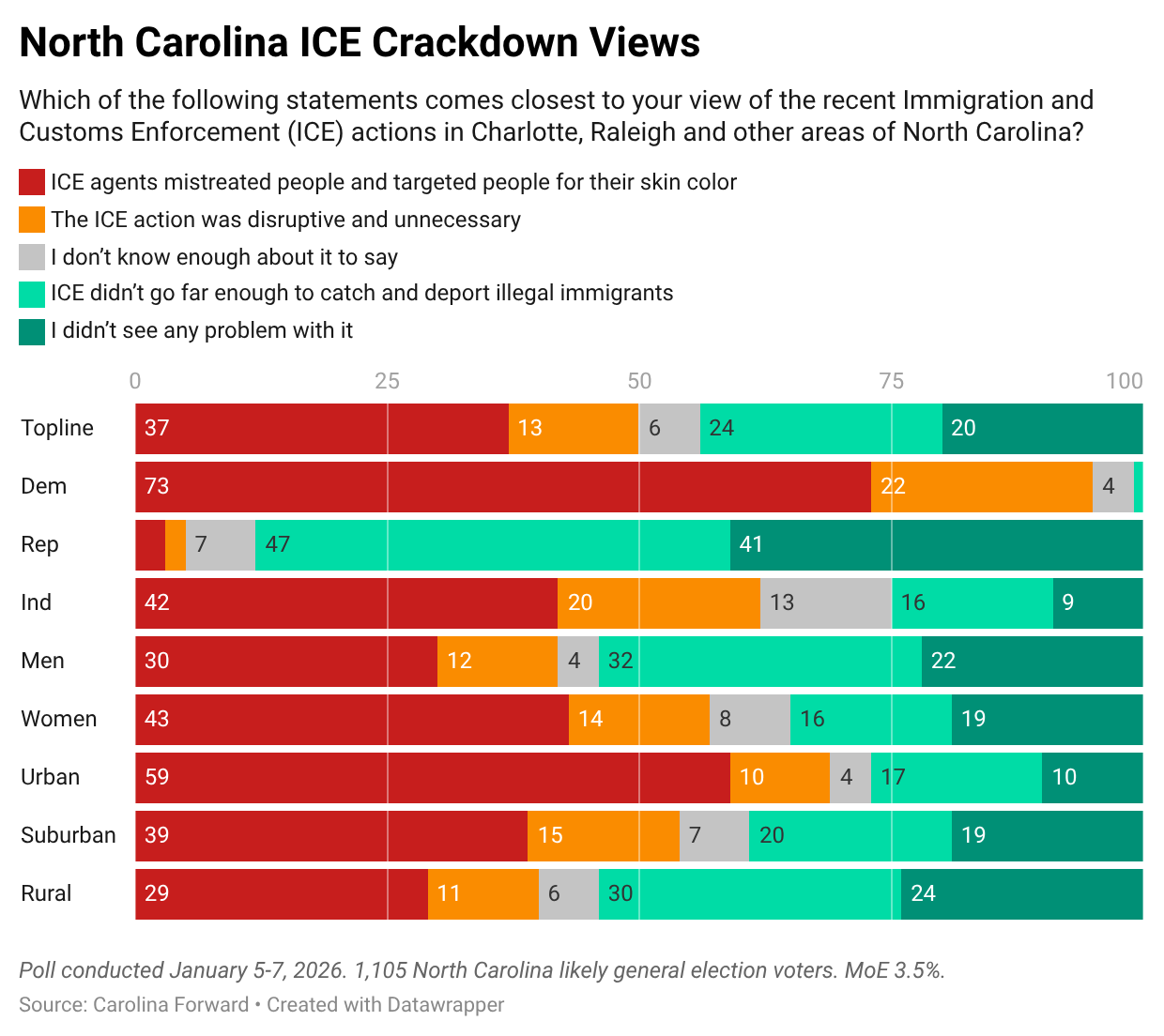
As expected, responses to this question are highly polarized by partisanship, with independents strongly siding with Democrats.
One interesting observation about this question is that it references events - “Operation Charlotte’s Web” - that occurred some time ago, just before the holidays. The ICE crackdown mostly concluded before Thanksgiving in November 2025. Thanksgiving, Christmas and New Year’s passed in the intervening 6 weeks before that conclusion and the fielding of this poll on January 5th. Despite that distance, the crackdown retains strong recall and resonance with voters, with only a very small proportion saying they “don’t know enough” about it. Most of that recall is distinctly negative.
(This poll was also out of the field when Renee Good was shot and killed by ICE agents in Minneapolis on January 7th.)
Independent redistricting for me - but not for thee
This poll took a new twist on the long tradition of polling North Carolina voters about their appetite for independent redistricting.
For years, polls from different ideological points of view have found that North Carolina voters broadly support the idea of an independent redistricting system which would end partisan gerrymandering. But in this survey, we took the investigation one step further: would partisan voters still support independent redistricting, if their opponents could conceivably benefit? It turns out that many of them would not.
First, voters were asked if they would support a system of independent redistricting. Then, as a follow-up, self-identified Republican respondents were separately informed that “some experts believed” that such a system could benefit Democrats, while self-identified Democratic respondents were told the opposite. This additional piece of information significantly changed responses.
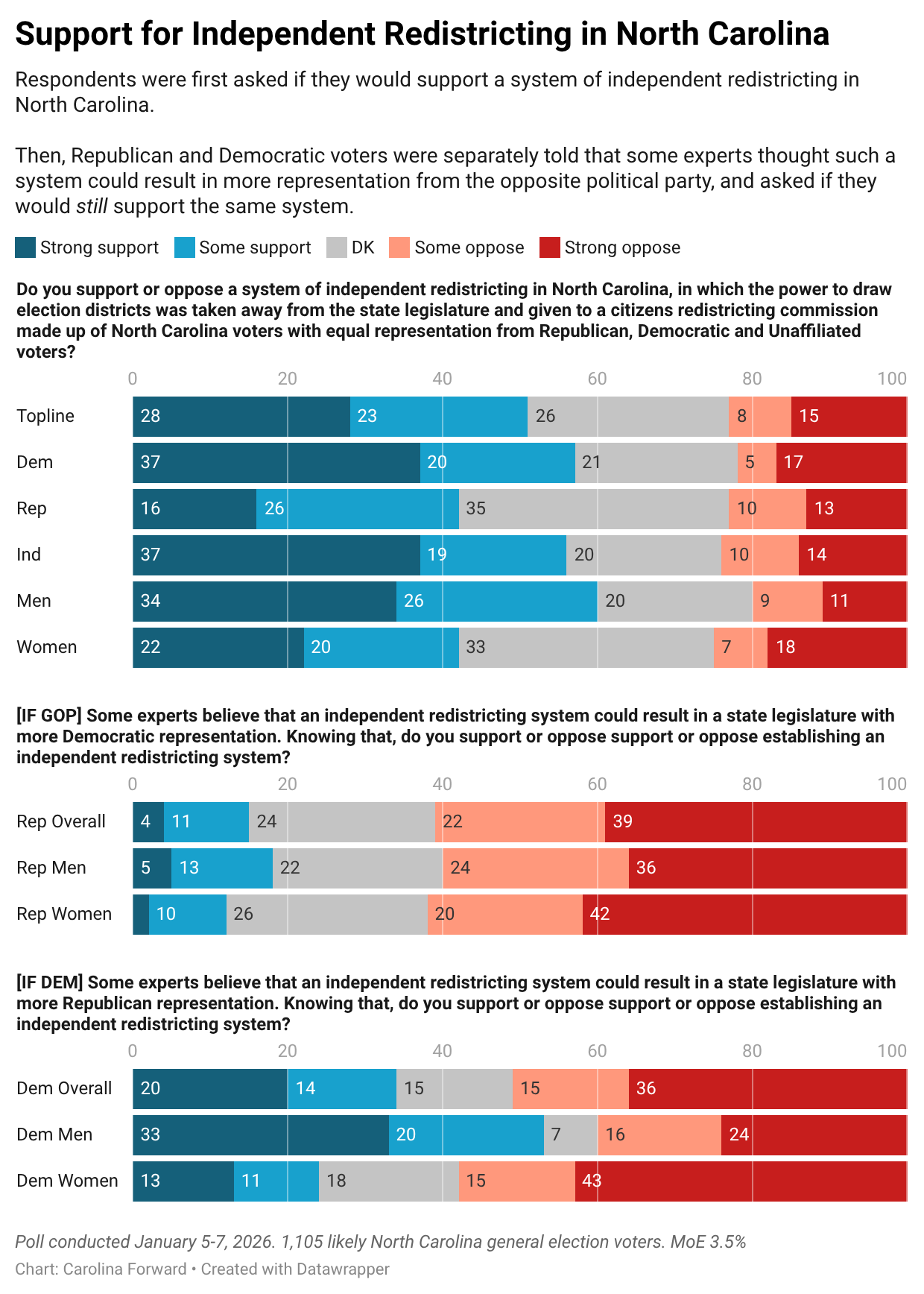
When informed that a system of independent redistricting could result in more Democratic representation, Republican support flips from +19 net support to -46 net opposition - a head-spinning 65-point swing.
Democratic voters, when informed that a system of independent redistricting could result in more Republican representation, flip from +35 net support to -17 net opposition - a similarly dizzying 52-point swing.
While Democrats appear to be modestly less so, both party bases appear to be much more strongly influenced by partisan gain than principle when it comes to ending gerrymandering in North Carolina. To successfully end partisan gerrymandering as Democratic lawmakers in Virginia did in 2019, or as voters in Michigan secured, lawmakers of either party would need ironclad principle to resist the demands of some of their base for partisan vengeance.
Methodology
The full toplines report and crosstabs are available here.
The Carolina Forward Poll was conducted by Change Research, who surveyed 1,105 North Carolina likely general election voters from January 5-7, 2026. The poll has a margin of error of +/- 3.5%.