In 2023, corporations and special interests set a new all-time high record for spending on lobbyists in the North Carolina state legislature. According to new data from the NC Secretary of State, a total of $78.3 million was spent just in the 2023 calendar year on lobbying - a whopping 20% jump from 2022, when spending on lobbyists hit $65.3 million. 2023 is the most recent year for which comprehensive lobbying spending data is available.
This represents an enormous surge in lobbying spending in a year when Republicans gained a legislative supermajority following the premeditated party-switch by Republican State Rep. Tricia Cotham (see: Defrauding the Voters of Mecklenburg). Under the Republican supermajority legislature, both the number of entities lobbying the legislature, as well as the amounts they spent, shot up significantly.
Who’s lobbying
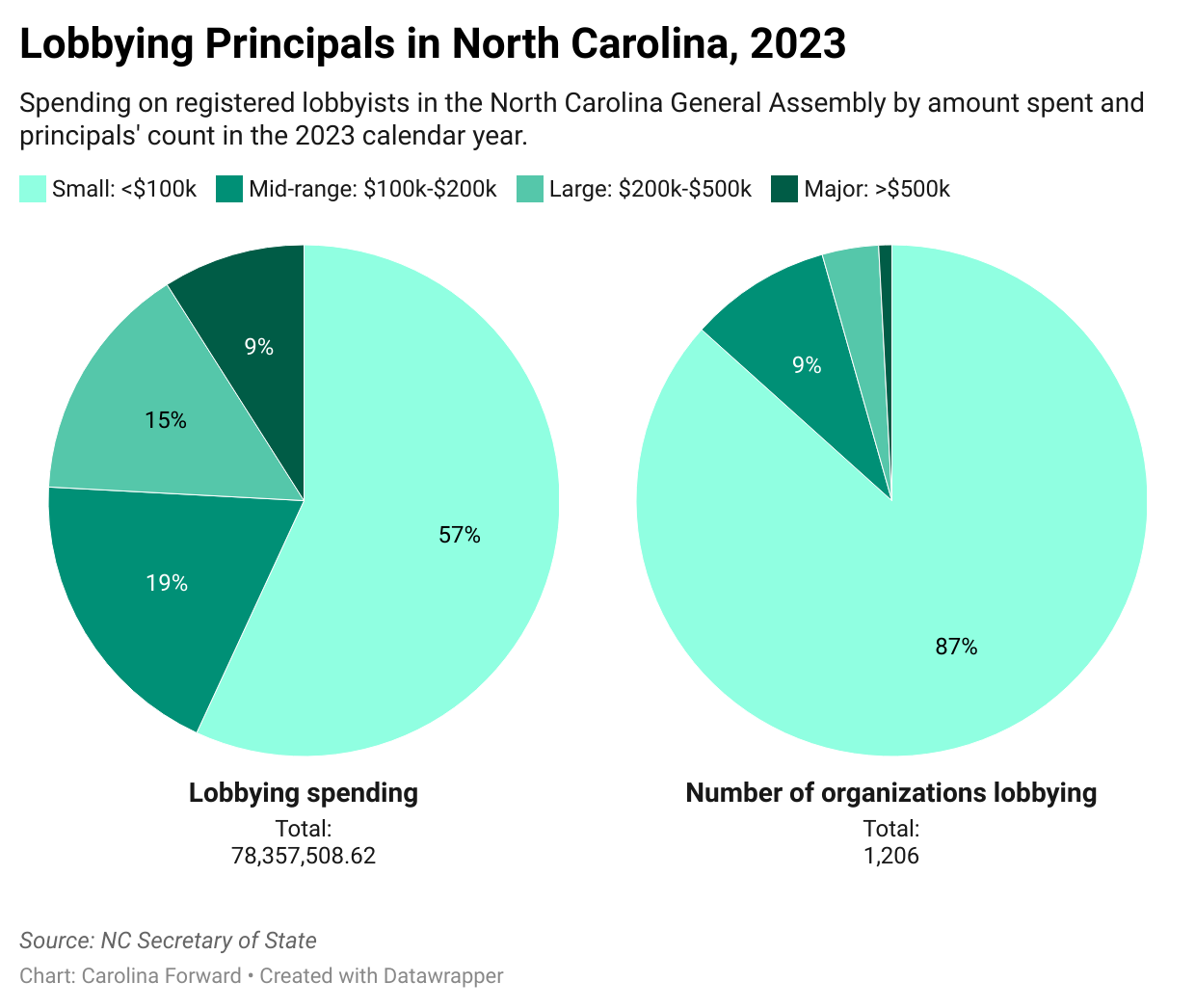
Data on lobbying spending is public record from the NC Secretary of State’s office, where all registered lobbyists are required to disclosure both their principal clients as well as what they are paid. Compared to the 2022 figure, 135 new entities began lobbying the legislature in 2023, and total lobbying spend rose by over $13 million:
Note: all data for the charts and information in this article can be found in this spreadsheet.
The top five lobbying entities by total spend were:
- NC Chamber of Commerce ($900,451)
- Blue Cross Blue Shield of NC ($897,606)
- Duke Energy ($832,502)
- Centene Corporation ($760,776)
- Farm Bureau ($751,410)
While the large majority of lobbying entities were small (defined as <$100,000 in total spend), total lobbying spending was very disproportionately driven by larger organization. Mid-range ($100k to $500k) and larger (>$500k) entities made up 43% of total spending, despite comprising only 13% of all lobbying principals.
Lobbying by local governments
One noteworthy trend in 2023 was the dramatic increase in the number of local county, city and town governments that paid for lobbyist representation in the state legislature.
In 2023, a third of all county governments in the state (33) paid for lobbyist representation, as well as 23 cities and towns. They paid $1.8 million and $1.2 million in lobbying expenses, respectively. This represents a significant increase in the number of counties that paid for lobbying, up from 19 in 2022 and only 11 in 2021.
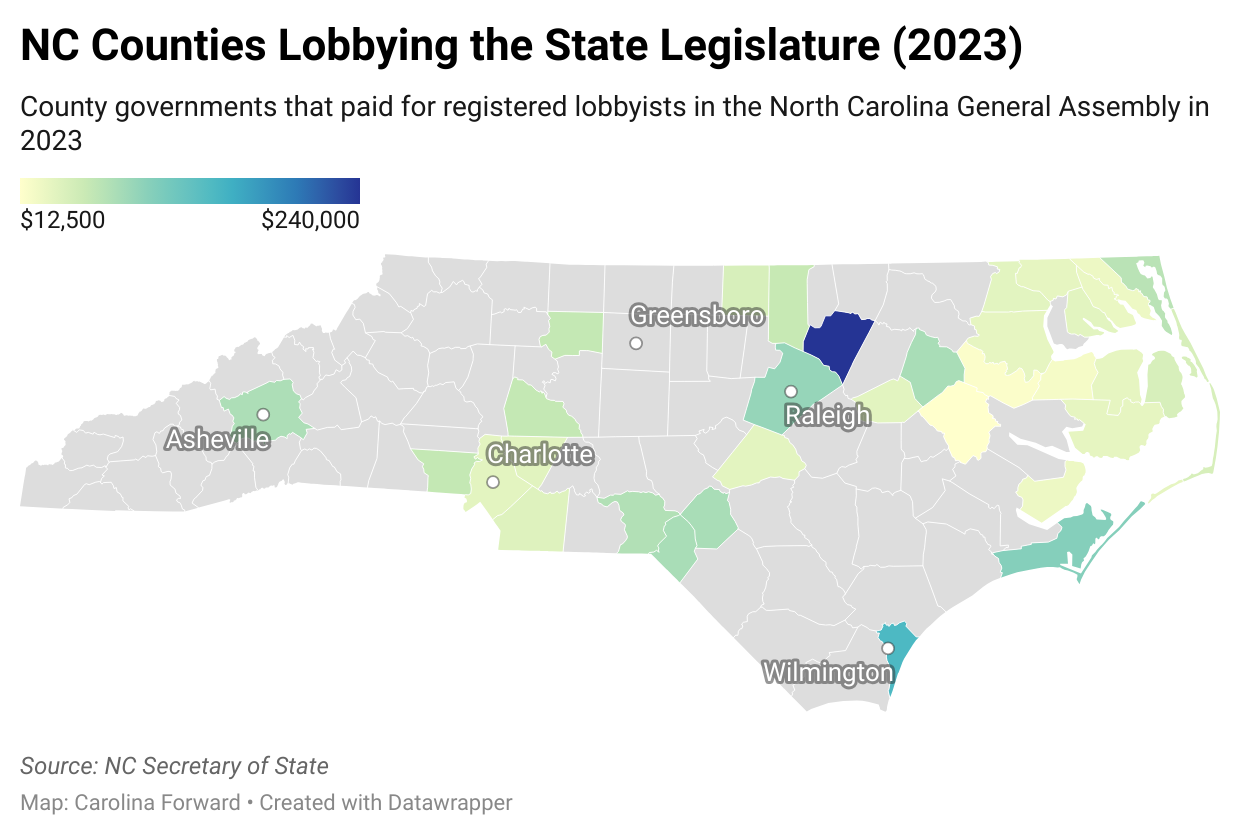
One major outlier in this group was Franklin county, which paid a whopping $240,000 in lobbying expenses. There was also a notable increase among northeastern counties, many of whom paid nearly as much as did Mecklenburg county itself.
Why lobbying costs are rising
The simplest explanation for the sharp surge in lobbying spending in the 2023 North Carolina state legislature has to do with the Republican supermajority. Due to pervasive partisan gerrymandering, North Carolina’s state legislature is effectively immune from voter accountability. The most effective means for special interests to press their agenda is through direct influence with lawmakers, not at the ballot box or in political campaigns. In a supermajority legislature, influence shifts even further the the most extreme end of the political spectrum, and increasing the number of favor-seekers among a small group of influential lawmakers.
While pay-to-play politics are hardly new to North Carolina’s state legislature, the corrupting influence of monied special interests has thoroughly distorted the state’s politics for years on end now, and this process has been actively encouraged by the leaders of our legislature. The proof is in the data: it’s a good time to be a lobbyist in Raleigh. Voters, however, have no such good fortune.