
As in most states, North Carolina’s economy has long been supported by its major business hubs. For many decades, the economic engines of cities like Raleigh, Durham, Greensboro/Winston-Salem and Charlotte have been generators of economic growth that support and complement economies around the state. Since time immemorial, our urban economies have grown in balance, and often symbiosis, with rural ones.
But since 2010, North Carolina’s economic growth has tilted significantly towards large metro areas, leaving rural communities behind. In that period, the share of North Carolina’s entire statewide economy generated just by its two largest urban counties has swelled, while that of the rest of the state has contracted.
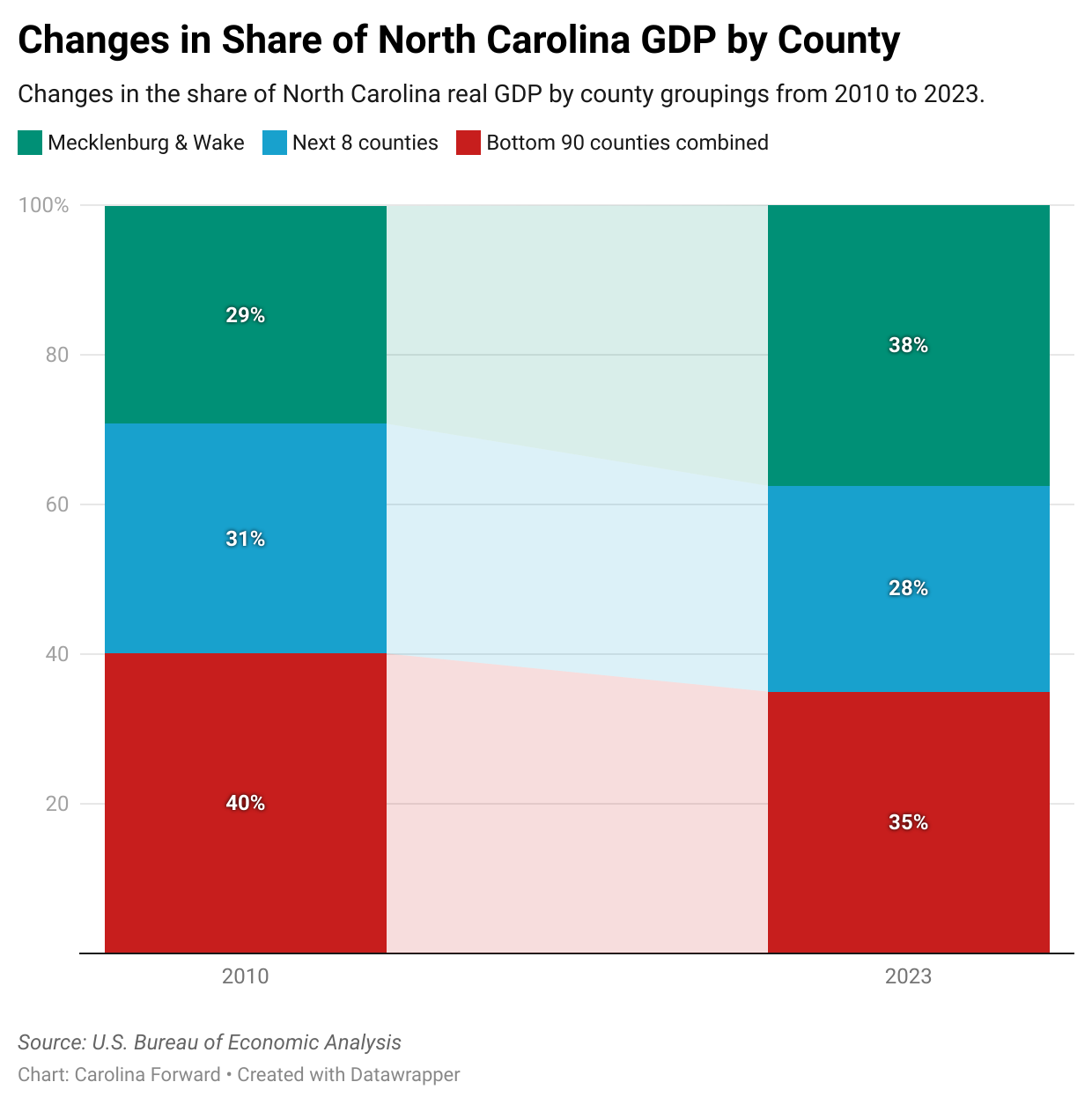
Analysis of the last 13 years of real GDP (eg. adjusted for inflation) provides a good illustration of just how much North Carolina’s statewide economy has come to rely on the county economies of just its two juggernauts: Mecklenburg and Wake.
In 2010, North Carolina’s 90 smaller counties by GDP collectively powered a plurality (40%) of the state’s entire economic output by a measurable margin. But by 2023, that lead had flipped. Today, Mecklenburg and Wake alone power 38% (a plurality) of North Carolina’s entire economic output. (As of this writing, real GDP figures for 2024 are not yet available from the U.S. Bureau of Economic Analysis.)
The reason for this shift in balance is simple, at least when one examines the numbers: for 32 out of the state’s 100 counties, their county economies have shrunk over this period.
In rural Edgecombe and Person counties, for example, their countywide economies shrank by a third in 13 years. While the economic decline in most shrinking counties was not that drastic, a third of all counties in the state nevertheless saw contracted economic activity. Every single one of the 32 counties experiencing a shrinking economy is rural (as defined by the NC Rural Center).
Even in counties where the economy has not shrunk since 2010, many of these “growing” economies were actually quite stagnant. A whopping 46 counties - nearly half - have seen annualized real economic growth rates of 2% or less since 2010. In 28 of those counties, the growth rate was 1% or less per year.
For the one-third of all NC counties experiencing shrinking economies over the last 14 years, this has meant lower standards of living, fewer opportunities, shortened horizons and clipped ambitions. This has fueled much of the depopulation of North Carolina’s rural communities over the period. In the 28 other counties where local economies have barely budged, the situation is not altogether different.
The common denominator connecting stagnant or shrinking local economies across the state are that they are predominantly rural. Even a cursory glance at the map above confirms what many know intuitively: economies linked closely to major metropolitan areas have generally fared well, while those that aren’t, have not. Only 12 of North Carolina’s 78 rural counties experienced annualized economic growth of 2% or more over this period.
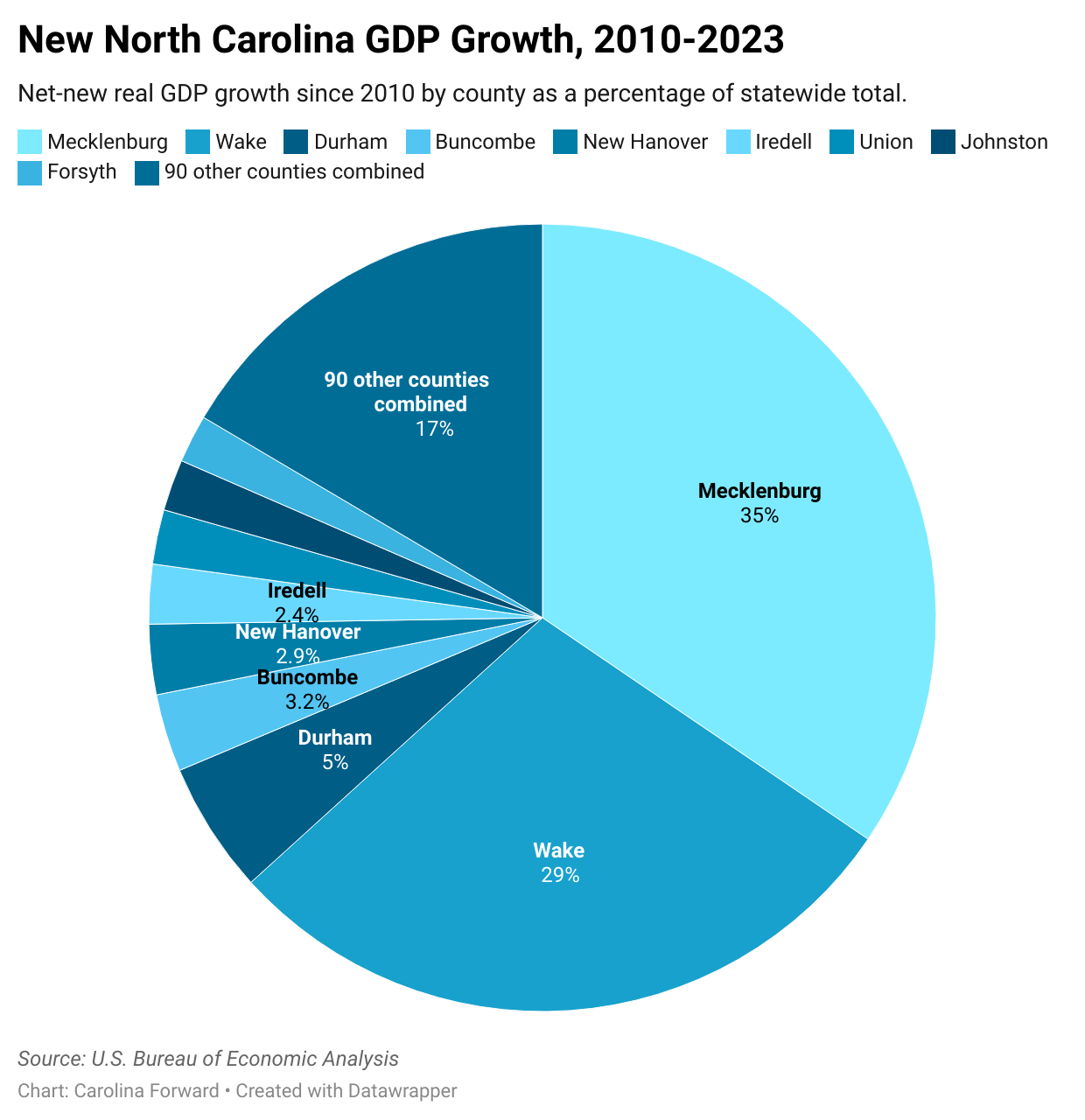
Another way of visualizing how lopsided North Carolina’s economic growth has been is examining the absolute net-new growth since 2010.
Breaking down the absolute value of new contributions to North Carolina’s statewide real GDP since 2010 confirms that our state’s economic growth has become vastly more concentrated in a small number of areas. Mecklenburg and Wake county alone have been responsible for a whopping 64% of all new economic growth since 2010. The bottom 90 counties combined have contributed only 17%. (This is why Mecklenburg and Wake have grown their share of North Carolina’s total real GDP growth, and the 90 smaller counties’ share has shrunk, as shown in the graph above.)
The last 15 years have been a painful period of economic ruin for rural North Carolina. Economic contraction has fueled depopulation and a shrinking tax base, which in turn has limited local governments’ ability to make investments to intervene.
Yet help from North Carolina’s state legislature has been tepid, if not nonexistent. North Carolina’s leaders obstinately refused to expand Medicaid until 2023, and even that lifeline now appears short-lived. State leaders have eroded support for public schools and infrastructure. The emaciated role of North Carolina’s state government itself has plainly not limited the horizons of powerful industries in the state’s biggest metro areas - but it has been a brutal era for rural residents, who have been left behind by their lawmakers.