One of the central arguments made by opponents of public education is that North Carolina taxpayers spend too much on their children and schools. Even as the state continues to rank near-bottom in the nation for school spending, some on the political right charge that the number is still too high. Specifically, opponents blame “administrative bloat” in North Carolina’s public school system for soaking up resources that should go to classrooms instead.
In but one example, failed Republican candidate Michelle Morrow claimed that there had been a 265% increase in funding for “administrative and bureaucratic stuff” (what time frame she was referring to was left unclear). Failed Republican gubernatorial candidate Mark Robinson repeatedly decried a “bloated bureaucracy” in the school system, which he said needed to “cut the fat.”
But like much of what Robinson and Morrow had to say, these claims do not survive the first contact with evidence.
In fact, data from the North Carolina Department of Public Instruction itself shows the very opposite: over the past two decades, our public school system has increased resources to students, not administrators.
What the data shows
Every fiscal year, the North Carolina Department of Public Instruction (DPI) releases its “Highlights of the North Carolina Public School Budget” report. This report is a trove of data about system spending from the previous year. These reports, with data going all the way back to 2004, give a very clear look at where the public school system’s money goes.
First up, central office spending. Every year, the DPI budgets a certain amount of money for central office administration. To account for inflation, we represent this amount as a proportion of each year’s overall schools budget. In the last 20 years, the amount spent on central office administration has fallen by nearly half.
Note: all data can be found here, sourced directly from the NC Department of Public Instruction.
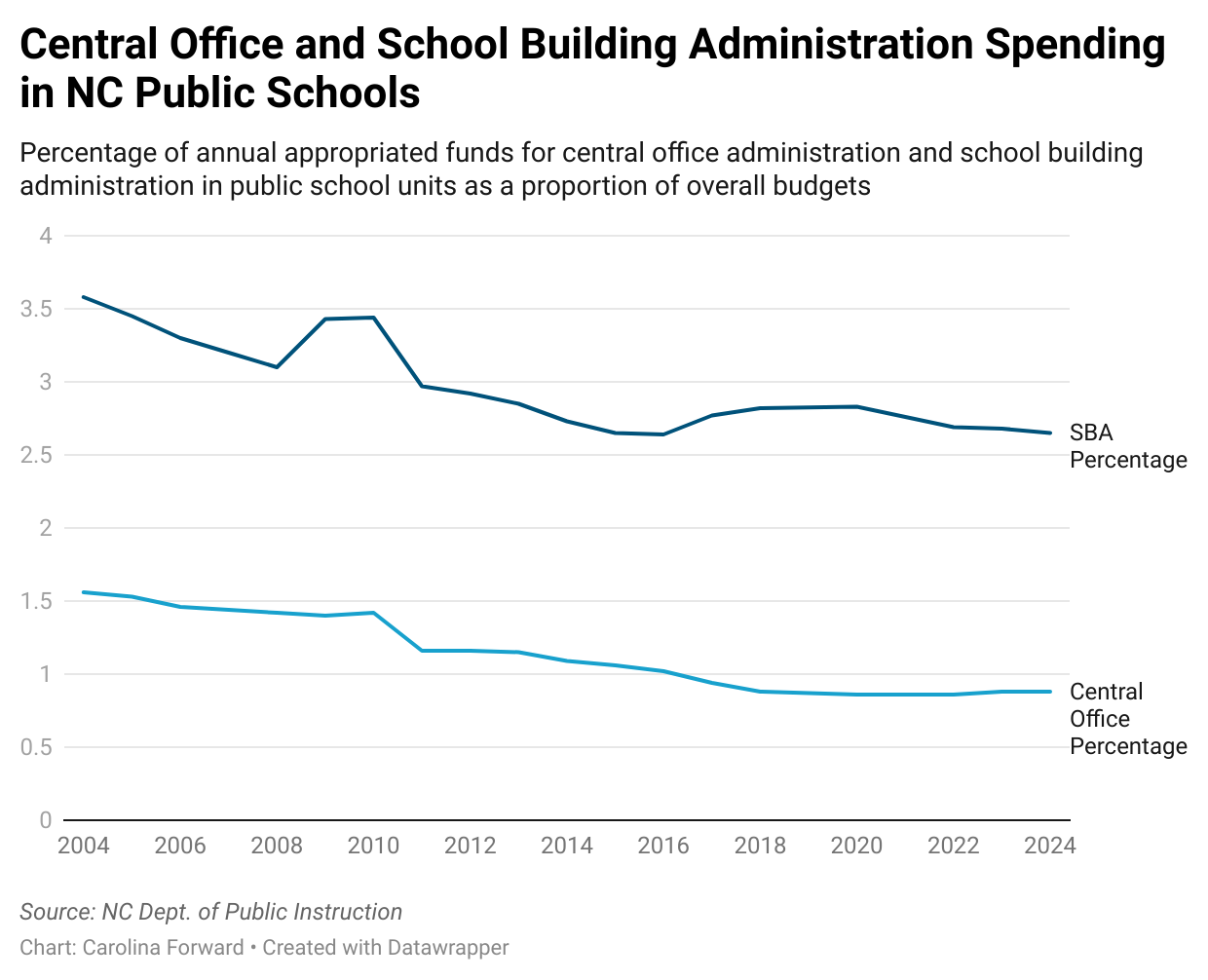
In the 2004-2005 school year, central office administration accounted for 1.56% of the overall education budget (a little over $100 million in 2004 dollars). By comparison, the state spent over $2.4 billion on classroom teachers that year. In 2024-2025, even though the budget dollar amount has increased due to inflation, the state now spends less on central office administration than we did 20 years ago: only 0.88%.
Of course, central office spending isn’t the only form of non-classroom spending. There’s also spending on school buildings themselves: purchasing, construction, maintenance and more. Here too, while the total dollar amount has increased from 2004 to 2024, due to inflation, it has decreased as a proportion of year-to-year funding requirements, from 3.58% in 2004 to 2.65% in 2024.
The story is the same for “non-instructional support personnel” category, which has always been a small fraction of spending and has decreased: from 4.74% of the budget in 2004 to 4.03% in 2024.
Combined, all three of these spending categories took up less than 10% of spending in 2004, and were down to 7.56% in 2024.
So where does it all go?
If school budgets aren’t being eaten up by central office expenses, then where does most of the money go?
The answer is anti-climatic: it’s education_._ Every year, the vast majority of North Carolina’s schools budget goes to instructional personnel and related services (dubbed IPRS), which includes classroom teachers, teacher assistants, classroom materials, supplies, textbooks, and annual leave. While DPI highlights that this category includes school building administration, even after backing that out, it has constituted a healthy majority of spending every year.
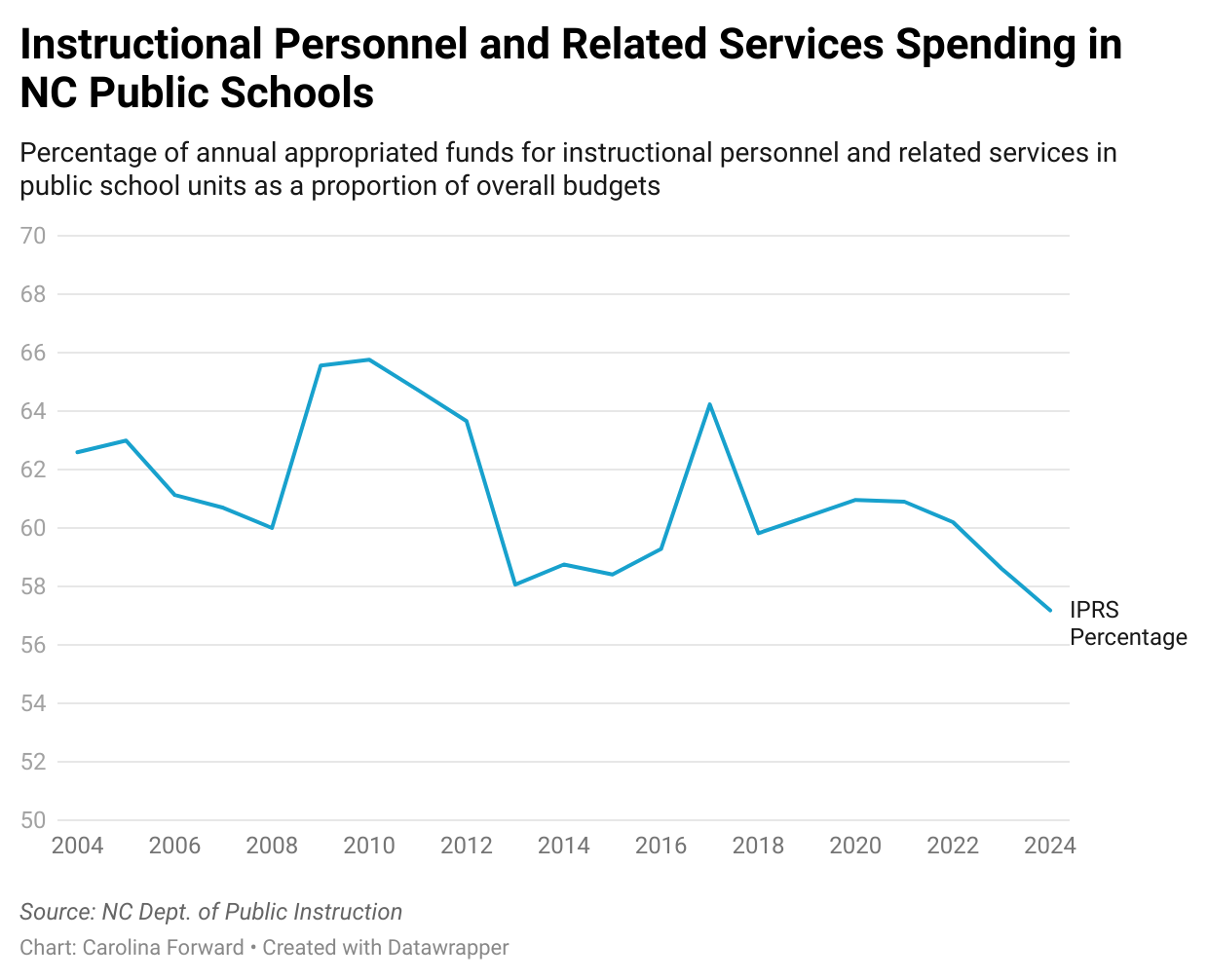
Careful observers will note that the IPRS proportion has also been gradually decreasing slightly,from 66.17% in 2004 to 59.83% in 2024. However, this can mainly be explained by the rise in spending on “categorical programs.”
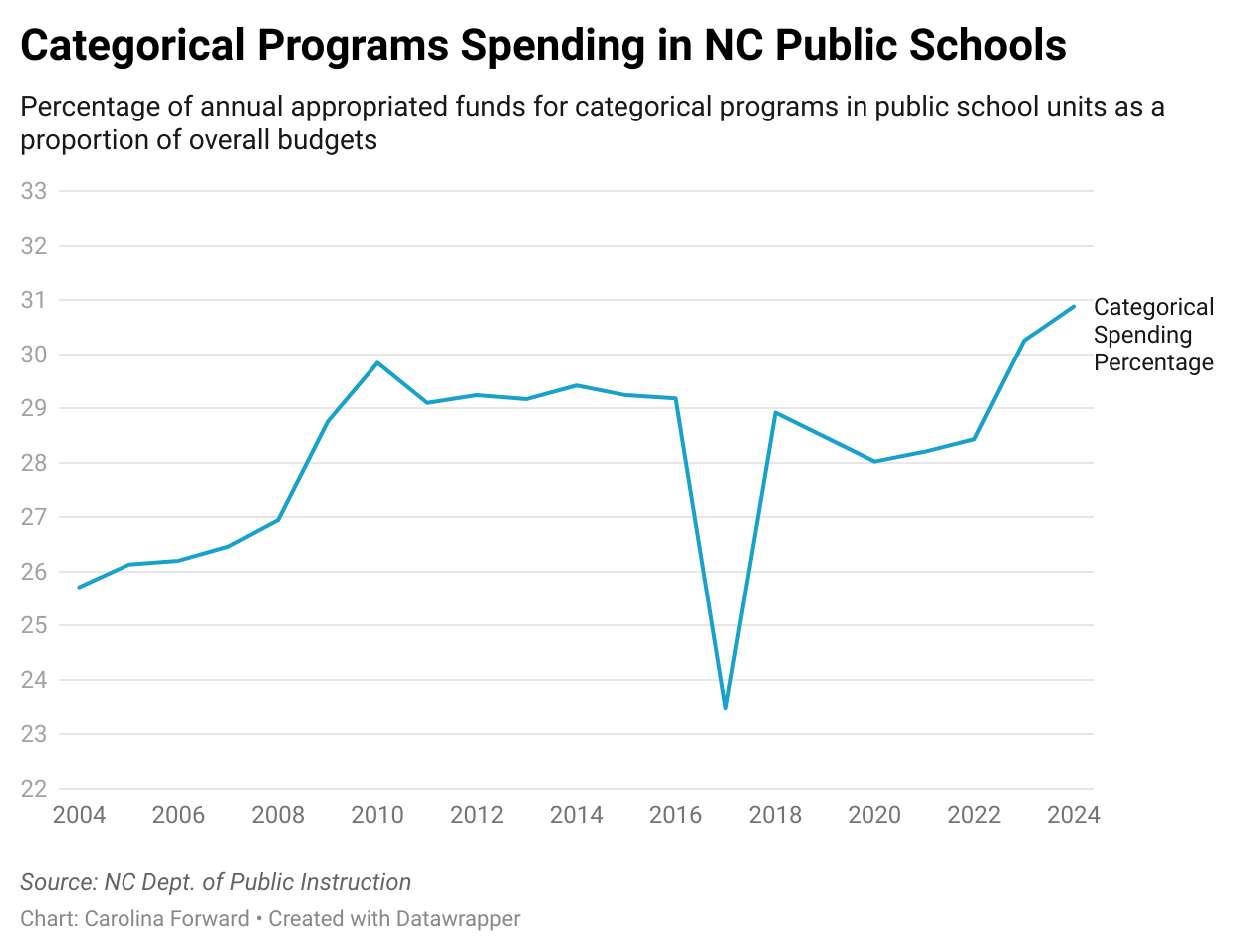
“Categorical program” spending is broad, but encompasses programs that help specific student populations. In 2024, categorical spending included spending on:
- gifted programs
- at-risk student services
- disadvantaged and disabled students
- driver’s ed
- school technology
- career and technical (eg. vocational) education
- literacy interventions
- summer reading camp
Funding for these programs totals out at 30.88% of our state’s budget in 2024, up from only 25.71% of the budget in 2004. There are also school-level programs, including transportation for homeless and foster students, which take up 1.34%, and a category of other public school appropriations, including things like testing and school bus replacement, taking up 2.27%.
But what about headcount?
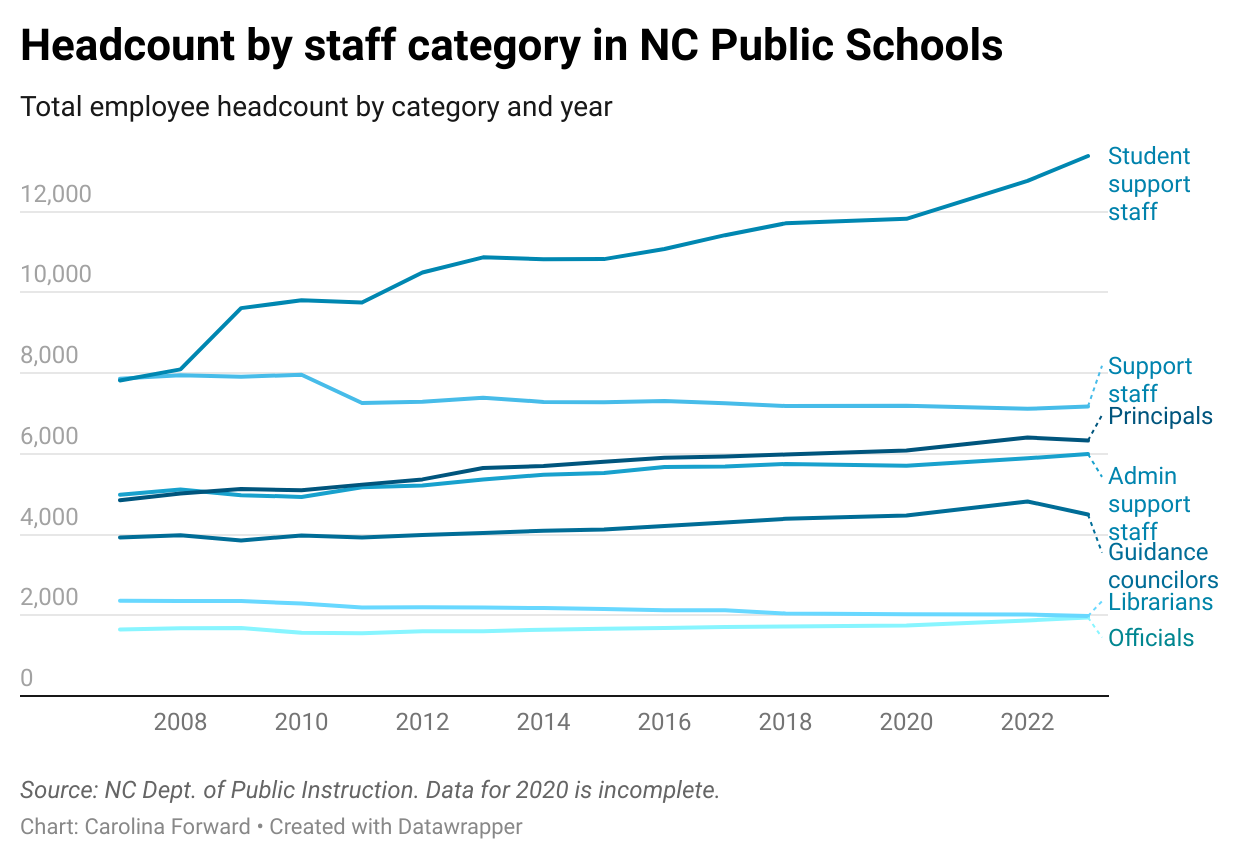
Turning to actual headcount employed in North Carolina’s public school system, the only obvious upward trend is in the “student support staff” category, which has increased by roughly 70% since 2007. This category of personnel is for staff who help serve, but do not instruct, students, like school attendance and health officers, those working in speech pathology, audiology, or social services, bus drivers and food service workers. Though 70% is a large number, it only represents the addition of about 5,500 more of these positions over 16 years between 2007 and 2023.
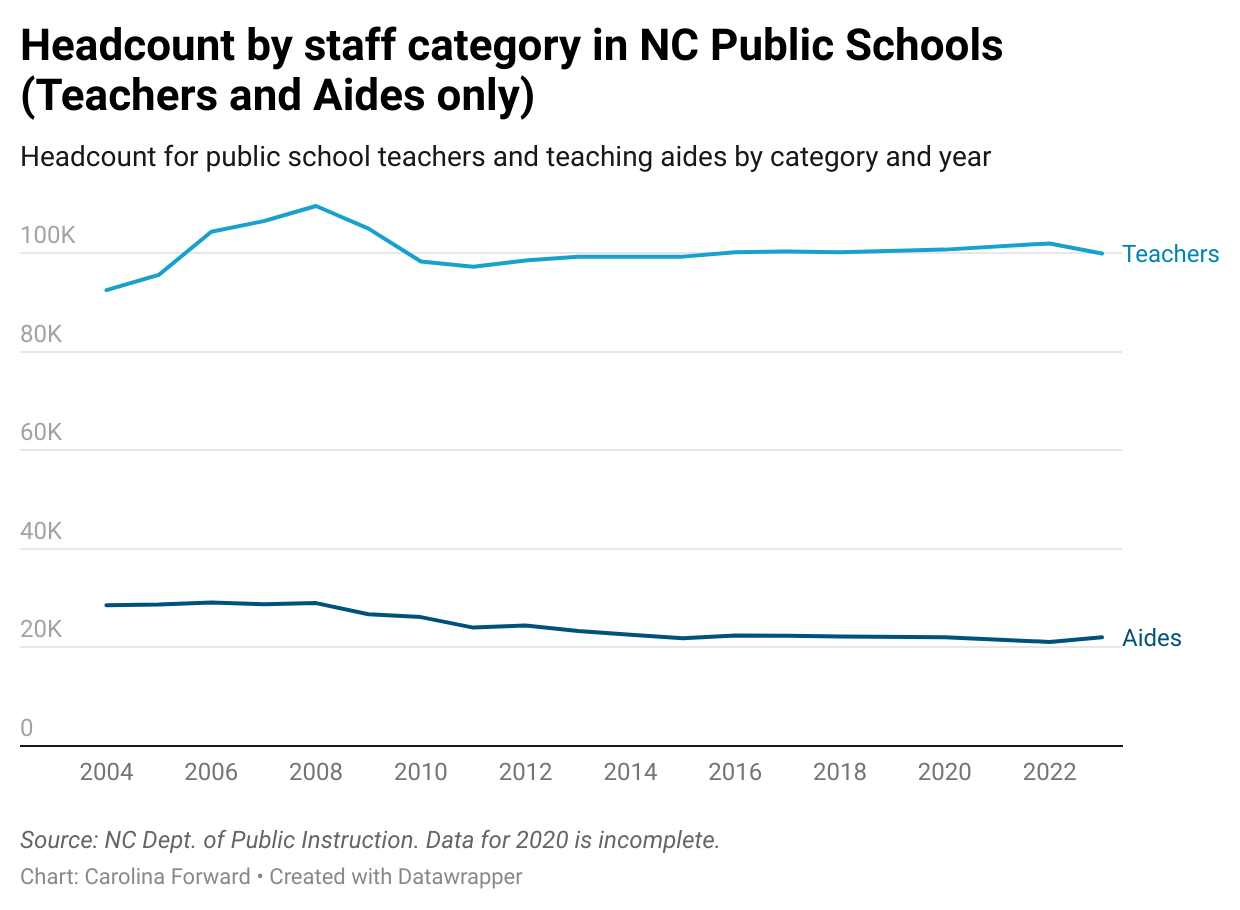
Of course, the single biggest category of staff are teachers and teaching aides, who are an order of magnitude more numerous than almost any other staff category:
Much to the dismay of opponents of public education, North Carolina’s public schools really do spend most of their money on students. Our public school system has been systematically been starved of resources for years by our state legislature, and there are certainly legitimate points about how the school system could be better structured, organized and operated. But a “bloated” central office administration is simply not a problem our schools face. Their problems are much more mundane: a lack of basic resources, support, and respect from lawmakers.