Up until 1997, there were two types of schools in North Carolina. Private schools, funded and supported by families themselves, and public schools, funded and supported by the state. However, since the late 90s, a new type of school has appeared and carved out a sizable niche in the education industry: the Charter School.
Charter schools function as independent nonprofit schools that are publicly funded. Traditional public schools generally follow school-district rules and regulations, such as standardized curriculum, while charter schools operate under “charters” that create an exemption from the same oversight as traditional K-12 public schools. In NC, all public school students are eligible to apply for charter school admission. Taxes from state and local governments are the main funding source for charter schools.
Some of the key differences in operations include Traditional public schools being required to follow the NC Standard Course of Study, provide reduced or free school meals, have 100% of teachers licensed or pursuing licensure, provide transportation, and adhere to safety standards for all students, whereas charter schools are not. Charter schools are also governed by an independent nonprofit board, while traditional public schools are governed by an elected school board.
Explaining “School Choice”
School Choice refers to using public scholarships or vouchers to support students attending private or charter schools. This allows parents to have alternative options rather than the traditional public school based on their residence. In 2024, NC passed a universal school choice program, joining nine other states in expanding this program to all K-12 students via the “Opportunity Scholarship Program”. This program focuses on helping families pay for tuition and fees for private schools by allowing any family to apply for a voucher regardless of income. This effectively removes students and taxpayer money that would be going to our public schools, and sends them to independent schools, not subject to the same requirements for quality or oversight.
As a result of voucher programs, traditional public schools are struggling with enrollment and retention nationwide. In North Carolina, the rollout of opportunity vouchers at the state level is projected to result in a decrease in public school enrollment over the next five years. As enrollment declines continue, some schools could face closures, primarily impacting rural and low-income areas.
Funding of Charter Schools
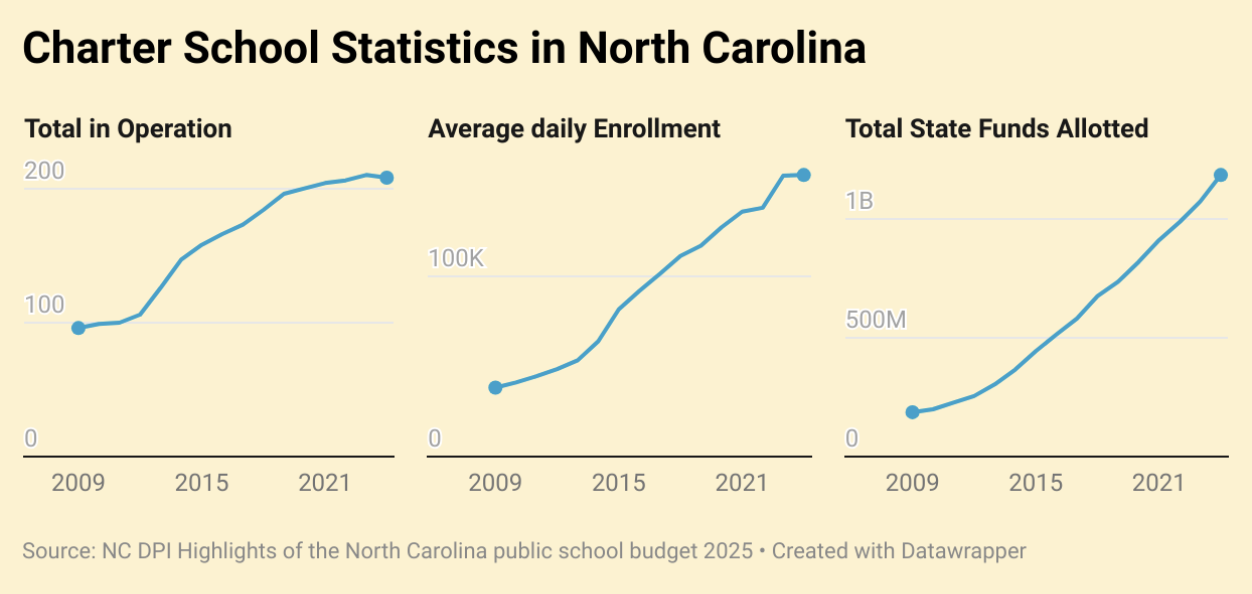
Charter and other independent public schools are funded heavily by state and local taxes. In 2024, the 211 charter schools in North Carolina received over $1 billion in state funding. The chart below shows the growth of these schools since the General Assembly passed legislation to create charter schools. In the last decade alone, charter schools in North Carolina have grown from $3.6 million to $1.18 billion.
The growth of charter schools isn’t just a local phenomenon. The Trump Administration has made expanding public charter schools and other alternative school options a priority. In September 2025, the Trump Administration awarded a $53 million grant to NC public charter schools with a focus on programs emphasizing career and technical training, STEM, and artificial intelligence. This program will create subgrants for charter schools that are aiming to recruit more students, further pulling students out of our public school system.
Oversight Mechanisms
Despite being publicly funded, charter schools lack the same oversight mechanisms as traditional public schools, which are primarily governed by local school boards. In July, Senate Bill 254 went into effect, which effectively stripped the State Board of Education of many oversight capacities and handed them over to the Charter School Review Board: A body composed mostly of General Assembly appointees.
The lack of effective charter school oversight gets to the main issue with charter schools and their place in our public education system. North Carolina lawmakers have repeatedly found ways to take public money and give it to charter schools, while also granting them greater and greater independence, akin to private schools.
Here in North Carolina, we respect public education. We have the oldest public university in the country. The right to an education appears several times in our law and constitution, including the state’s obligation to maintain a public school system. However, taking public money and using it to support schools that operate, in many cases, privately cuts directly against the values we are supposed to uphold.