
Over the last three years, Duke Energy’s rate increases have significantly outpaced inflation, gouging customers to defray their own costs and protect investor returns. Duke recently filed requests for additional rate hikes in 2027 and 2028, which would likely continue this trend.
Up until now, Duke Energy has provided electricity to North Carolinians under two different names, each associated with different service areas: Duke Energy Carolinas (DEC) and Duke Energy Progress (DEP).
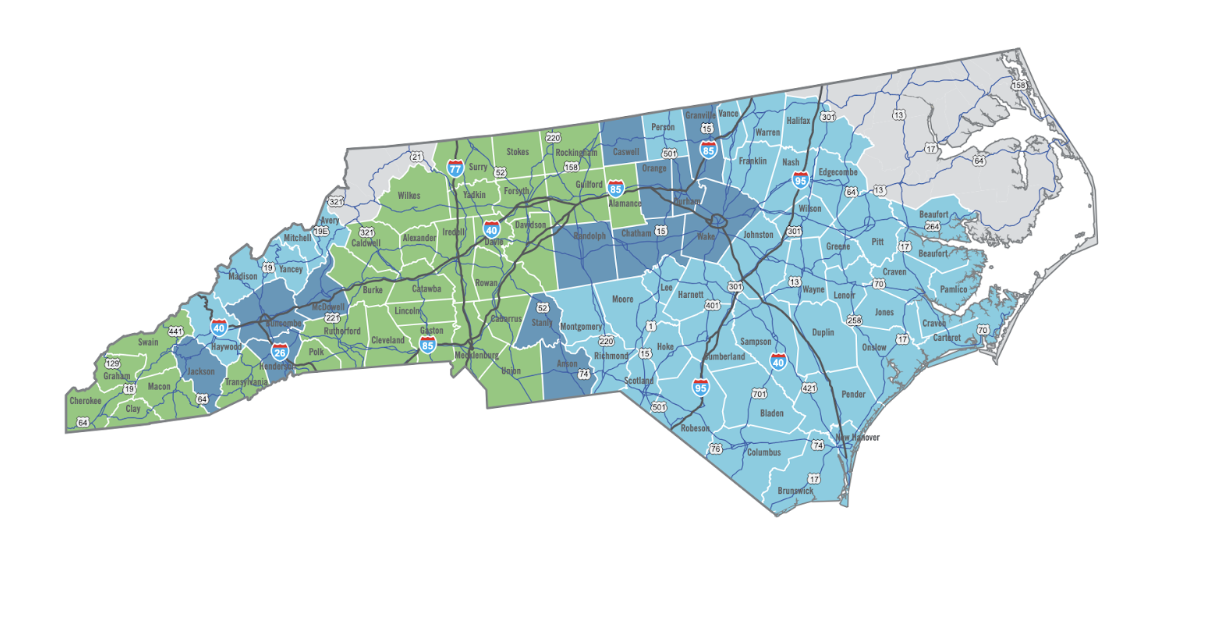
In the last set of approvals, Duke Energy Progress rates took effect in October of each year, while Duke Energy Carolinas rates took effect in January of each year, meaning that the 2023 rate increase for DEP is equivalent to the 2024 rate increase for DEC (because DEP’s 2023 rate applied for 3 months of 2023 and 9 months of 2024). Duke has also filed requests for an increase in rates in 2027 and 2028. The overall increase for both DEC and DEP is identical, although the impacts for residential customers will differ, if these rates are approved.
The full summary of rate hikes follows:
- For DEP:
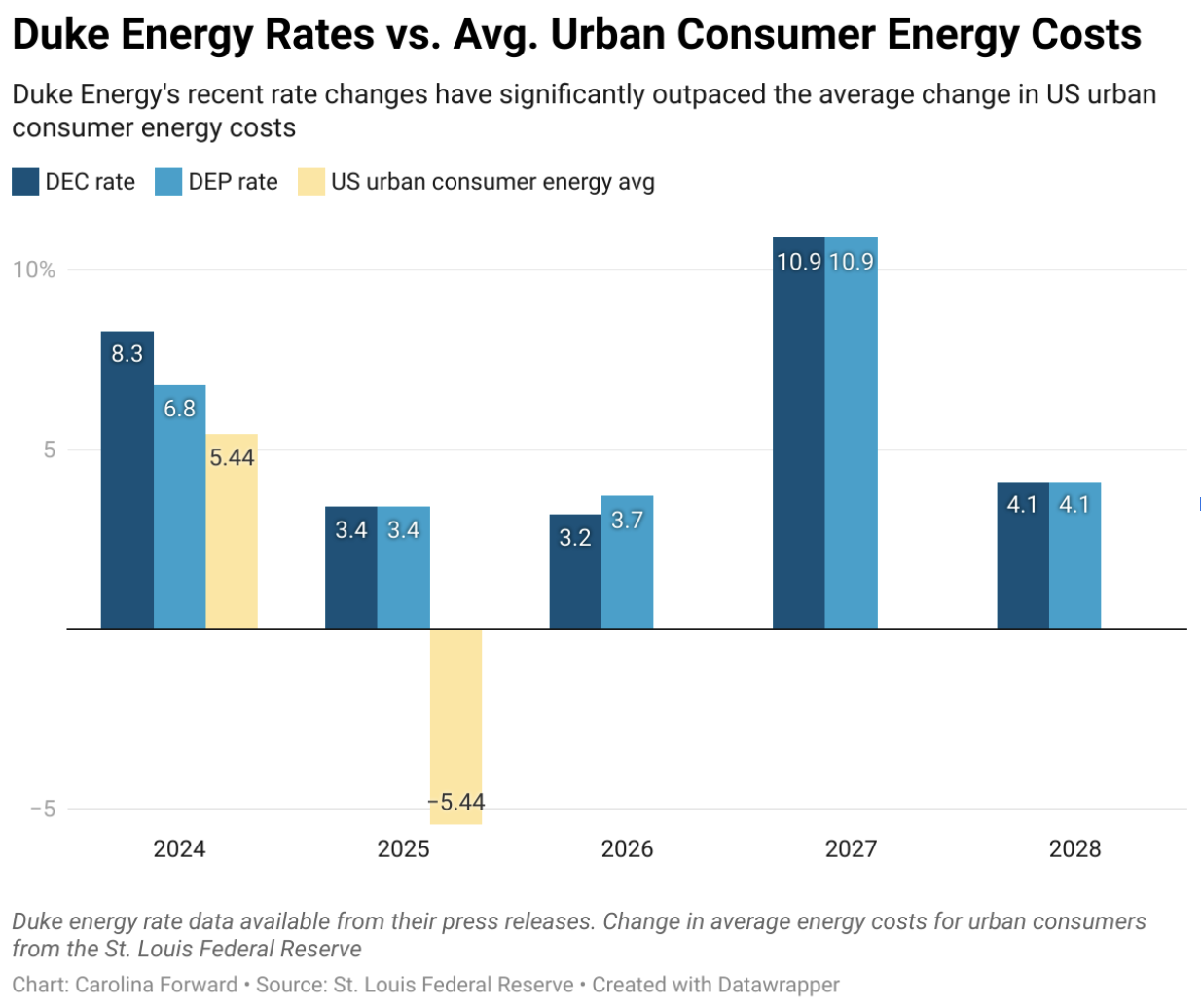
- 6.8% in 2023-24
- 3.4% in 2024-25
- 3.7% in 2025-26
- Planned: 13.9% for residential customers in 2027
- Planned: 4.2% for residential customers in 2028
- For DEC:
- 8.3% in 2024
- 3.4% in 2025
- 3.2% in 2026
- Planned: 13.5% for residential customers in 2027
- Planned: 4.5% for residential customers in 2028
A typical residential customer in North Carolina who consumed 1,000 kilowatt-hours of electricity per month paid about $140 on their monthly bill in 2023. Under Duke Energy’s planned rate hikes, that customer on Duke Energy Carolinas can expect to see their monthly power bill increase by $51.90 by 2029, a whopping 37% increase:
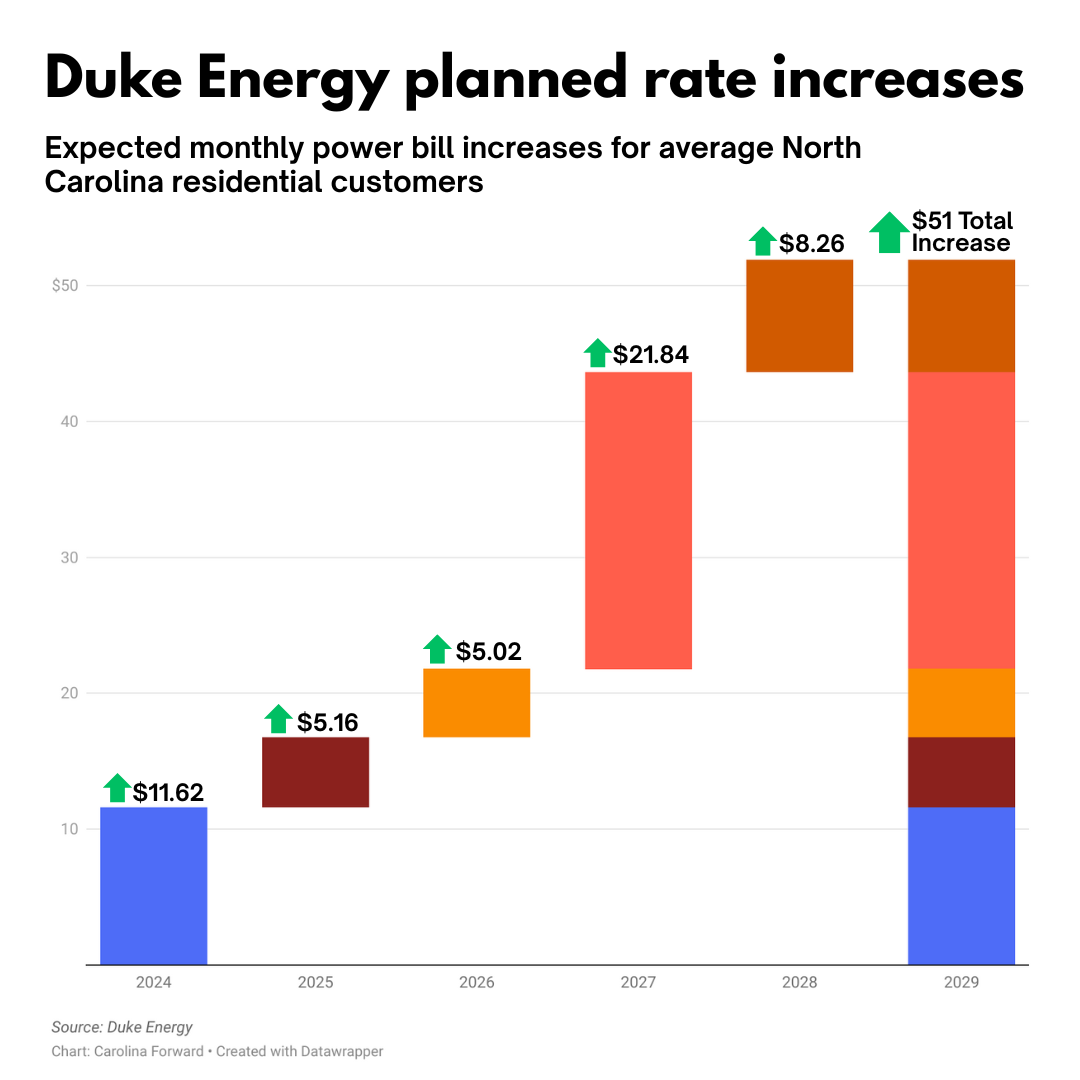
The corresponding figures for a Duke Energy Progress customer would be almost identical.
Under the approved rates, a $140 per month energy bill in 2023 will become $190.91 per month in 2029 for a DEC customer (once again, the figures for a DEP customer are nearly identical).
These rate hikes thus far significantly outpace inflation, as measured by the U.S. Urban Consumer Energy average:
These rate increases encompass only the average changes in the basic facilities fee and the energy charge. In addition to these base rate changes, which are approved in multi-year chunks, Duke is also legally permitted to make additional adjustments to other charges, called “riders,” on an annual basis. These include things like the cost of different fuel sources and the cost of storm damage repair.
Duke Energy is required by law to minimize costs for consumers, and the North Carolina Utilities Commission is legally empowered to monitor their costs and proposals to protect consumers. Unfortunately, the Utilities Commission has become a case study of regulatory capture, allowing Duke Energy’s lobbyists and proxies to game the system time and again without providing effective pushback.
As the NC Business Impact Forum has pointed out, Duke has created an artificial cap on the amount of solar infrastructure it builds each year, even though their own model shows that building more solar would actually save customers money. Instead, they’re forcing taxpayers to foot the bill for expensive nuclear infrastructure experiments, even though Duke has already failed on 19 separate occasions to complete proposed nuclear projects. The company hides critical cost data behind NDA agreements, which prohibit anyone who accesses the data from using it to reform the Utilities Commission’s cost assessment. And instead of using lowest-cost green fuels, they’re driving ratepayer costs up to fund new natural gas facilities, which could cost North Carolina households an extra $23 billion by 2050.
The North Carolina Utilities Commission is supposed to protect households from unreasonable rate hikes. Yet it’s hard to see how these new proposed rates could be seen as anything else.