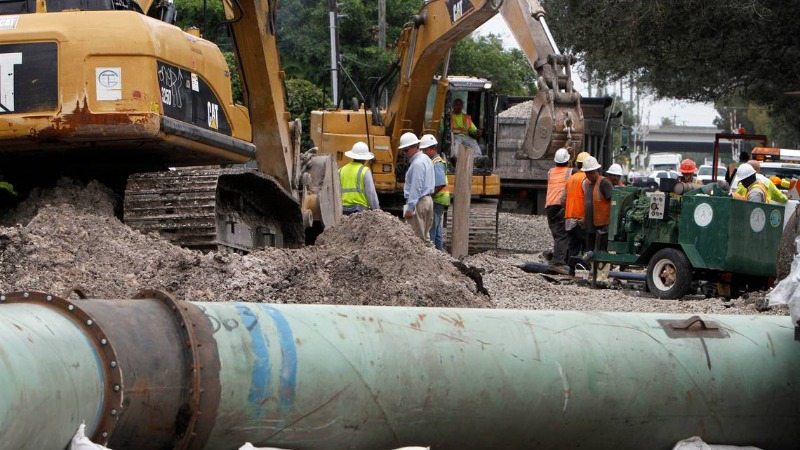
One of the state’s primary responsibilities is to administer infrastructure funding programs. Pooling our collective resources together through taxation is the only way that projects of this scale get built. And, doing them through the government, rather than through corporations, is why highways are free to use (instead of all being toll roads) and why publicly-owned drinking water is provided at the minimum viable cost (instead of maximum shareholder value).
Carolina Forward and Building NC’s Next Chapter have completed a new analysis revealing almost $120 billion in unfunded transportation, drinking water, sewer, and flood prevention infrastructure projects across North Carolina. This massive gap will only grow as the state’s income tax rates continue to drop, and would be exacerbated by the two tax cap amendments on your ballot this fall.
nc-unfunded-needWhat Is This?
This tracker includes every project with unmet state funding requests across two broad categories:
- Transportation: 2,163 highway, bike/ped, and transit projects that local governments and regional collaboratives submitted for state funding. These projects won some points, but didn’t score highly enough to capture some of the state’s limited transportation funds. Total unmet need: $115.8 billion
- Water/Sewer: 296 projects that applied for funds from the State Water Infrastructure Authority. These projects would have delivered clean drinking water, new sewer systems, reliability and disaster prevention upgrades, stormwater management infrastructure, and more. Total unmet need: $2.76 billion
This tracker understates the full scale of the need, since many projects that would serve a valuable purpose aren’t brought forward if the applicants know that they can’t win funding.
Why This Matters
One of the constitutional amendments on your ballot this fall would limit property tax revenues, which local governments lean on to plug critical gaps. Another would permanently cap the state’s income tax rate at a flat 3.5%. The income tax cap alone would block access to $17 billion in revenues that the state has the authority to collect today.
Here’s the problem: this list of unfunded projects already exists at today’s income and property tax rates. If we’re leaving this many projects undone today, how many more will we struggle to fund if costs keep rising and revenues stagnate?
Four Examples
- A crosswalk in Morganton - $474,800
A busy street with a poultry factory, a community college, an NC school of science and math campus and a state school for the deaf that doesn’t have a crosswalk. Pedestrians have been hit, but the project didn’t receive funding.
- A bridge that keeps flooding in Raleigh - $5,000,000
When Walnut Creek rises near Rose Lane, the bridge floods. Families get trapped. The city applied for stormwater funding from LASII, but didn’t receive any.
- ‘Forever chemicals’ contaminating Alamance wells - $924,190
Six homes on wells need to connect to an existing county line so they can get off of contaminated wellwater. They’re not alone; New Hanover county alone has asked for 15 similar extensions to get homes off of dirty well water and onto clean public water. There’s not enough money to go around.
- Sewer pumps in Bolton - $2,800,000
246 homes in Columbus county rely on grinder pumps to push their sewage into the town’s lines. The town has asked for funding, but keeps getting denied.
How To Use This New Tool
Pick your county from the dropdown at the top. You’ll see total unfunded need and a card for each project. Projects are organized from largest to smallest, and you may need to click ‘see more’ to review the entire list.
You can switch between the transportation and sewer tabs, and you can compare all 100 counties to each other on the third ranking tab. Badges on each tab provide additional context; the descriptions for each project come from the notes provided in public materials and meeting minutes.
As an example, if you look at Orange County, you’ll see 62 transportation projects worth $3.6 billion. A lot of that comes from enormously expensive road improvements. But there are also extremely popular projects like a $4.5 million sidepath along Seawell School Road, or $639,000 in sidewalk funding.
For each transportation project, you can click our “show on map” button to see where the project in question would be. We’ve included links to the NCDOT ArcGIS website and to the SPOT scores for these projects. If you open the NCDOT ArcGIS web link, be aware that there isn’t an option to highlight only the specific project you clicked on — you’ll see all the unfunded projects in the general vicinity of the project you clicked on in our tool.
We’ll revisit the rules governing North Carolina’s transportation funding in future posts. The point is, you can see an enormous, unmet demand for infrastructure across our state that will only get worse if voters cut off the state’s revenue sources.
Our Sources
Our water project estimates rely on data from the 2025 and 2026 Clean Water State Revolving Fund and the Drinking Water State Revolving Fund, as well as programs like the Biden-era Stormwater Funding Program. That funding expired and wasn’t renewed by the Trump administration, but the applications to that fund from 2022-2024 give a picture of the vast demand for new flood prevention and stormwater management infrastructure.
Transportation projects end up in something called the State Transportation Improvement Program (STIP). You can find a record of every project that didn’t receive funding in the last round in the state’s ArcGIS tool.
These are some of the most accessible project-level data records out there. The state publishes a five-year study of facilities needs for public schools, for example, but it doesn’t provide a comprehensive list of capital projects in each district analogous to these specific transportation and water infrastructure requests. We’ll plan to bring you a deeper dive into those project needs early next year, since a new five-year analysis of district capital costs is due by the end of this year. The last analysis, which was submitted in the 2020-2021 school year, identified nearly $13.1 billion in critical projects.
The answer to a high cost of living isn’t hamstringing our state. It’s empowering it to compete with the big corporations whose top, insider shareholders are siphoning more and more money away from ordinary people as food, medicine, housing, cars, insurance, and everything else get more and more expensive.