
Last fall, Attorney General Jeff Jackson reached a $7 million settlement with Greystar, North Carolina’s single largest apartment landlord, forcing the company to stop using RealPage’s algorithmic pricing software to set rents. This followed an earlier settlement last April. Both are very meaningful wins for North Carolina renters for which Attorney General Jackson deserves real credit.
But most North Carolinians struggling with housing costs shouldn’t expect meaningful relief from these legal victories alone. The real driver of North Carolina’s housing affordability crisis isn’t pricing technology - it’s a shortage of housing supply. North Carolina lawmakers should take steps to rein in the use of algorithmic pricing in our state because it contributes to higher costs for consumers. But to meaningfully tackle high housing costs, North Carolina must build.
What is Algorithmic Pricing?
Algorithmic pricing is a technology that uses data and mathematical models to determine pricing in real time. For decades, this approach has been standard practice across industries - albeit at modest scale, and with significant lag times. Airlines adjust ticket prices based on demand patterns and competitor pricing, and hotels change room rates based on occupancy levels and local events. More recently, ride-sharing services like Uber and Lyft have made “surge pricing” a household term.
In each case, the technology serves the same basic function: helping businesses maximize revenue by dynamically adjusting prices based on market conditions. In some sectors, like ride sharing, this type of algorithmic pricing has created real value for consumers. Yet in others, it can serve to enable collusion between a small number of sellers and significantly drive up costs for consumers.
The RealPage controversy
Imagine a scenario where the owner of one apartment building makes a private agreement with the owner of a nearby apartment building (or several such owners) that they will raise all of their rents by the same amount. This would have the effect of forcing most tenants to pay more, since tenants’ ability to “shop around” would be obviously limited.
This is the definition of collusive price fixing, and it is illegal.
Yet this is the product that RealPage, a Texas software company, offers its customers using algorithmic pricing. According to federal prosecutors and multiple state attorneys general, RealPage collected confidential information from competing landlords - rental prices, occupancy rates, discount strategies - and fed this data into its proprietary pricing algorithms that then recommended how those same landlords could most effectively raise rents. The software encouraged landlords to accept its recommendations, including “auto-accept” features, and discouraged price decreases.
The six landlords named in Attorney General Jackson’s lawsuit collectively manage approximately 70,000 apartments around North Carolina. That is approximately 5% of the roughly 1.4 million rental apartments in the state. It’s not a trivial number, but also not overwhelming.
In practical terms, RealPage’s system facilitated what prosecutors described as price coordination among competitors who should have been setting rents independently. Whether through handshake deals or algorithms, competitors agreeing to set prices together violates antitrust law.
North Carolina’s response
Attorney General Jackson has been rightfully aggressive in pursuing these cases. One of Jackson’s first acts in office was to join a bipartisan coalition of attorneys general suing RealPage to block its use. These recent settlements are meaningful shots across the bow that, at least for now, North Carolina’s Department of Justice will not tolerate collusion on rental prices. This is a rare win for the one-third of all North Carolina households who rent.
Yet long-term relief for high housing costs will take much more.
The cost of housing, like any commodity, is fundamentally a function of supply and demand. When demand for housing outpaces the available supply, prices rise. North Carolina is experiencing exactly that imbalance, and the numbers are stark.
A recent statewide analysis found that North Carolina faces a five-year housing inventory gap of more than 764,000 units, or 322,000 rental units and 442,000 for-sale units. Another report projects that the state’s household count will grow by 5% between 2024 and 2029, adding over 218,000 households, and that Wake and Mecklenburg counties alone are expected to add more than 76,000 new households.
But the inventory of available housing isn’t keeping pace.
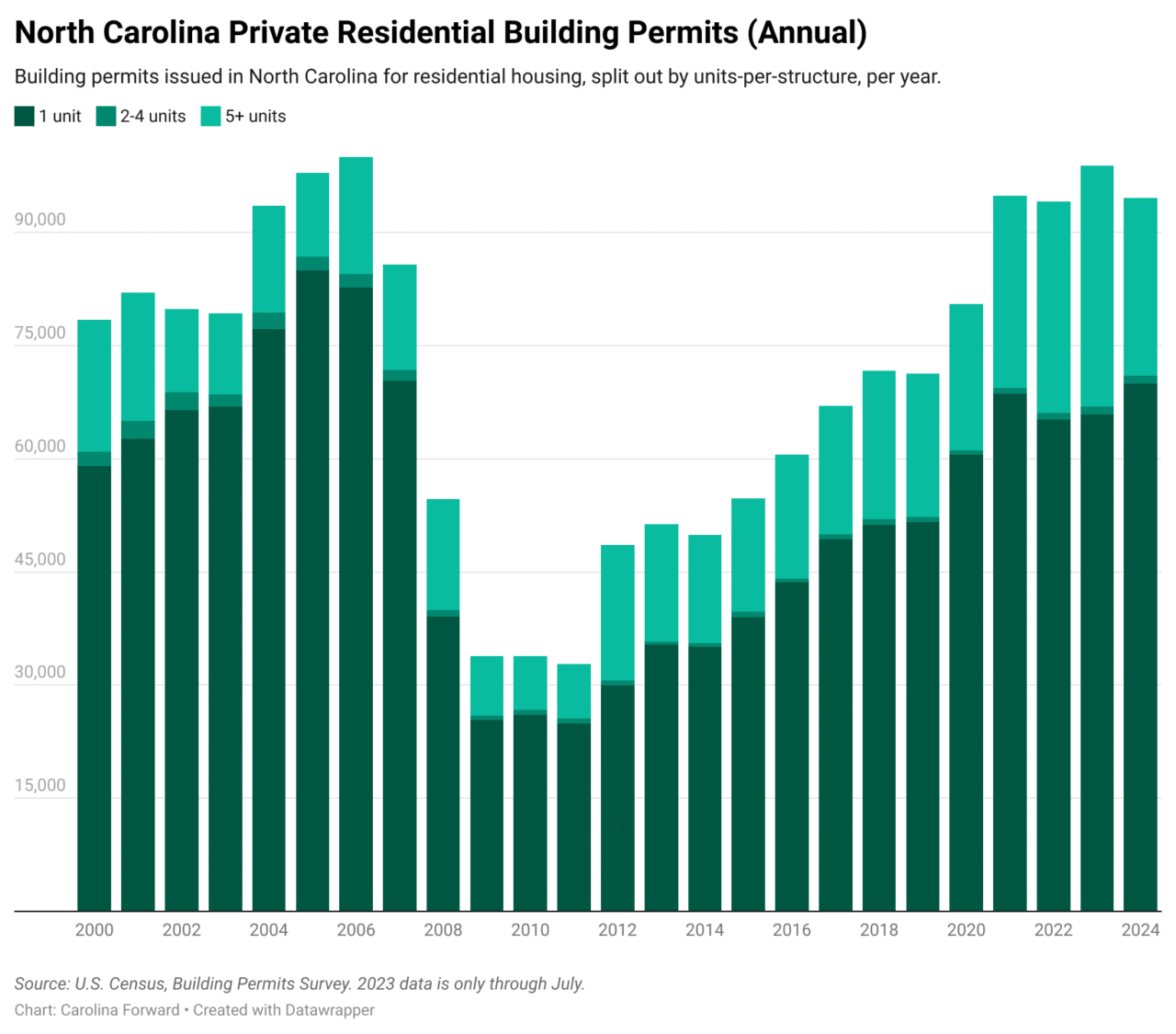
North Carolina has barely recovered its pace of housing construction since the Great Recession of 2008/2009, and the mix of housing constructed today is markedly different. While demand for housing has continued to grow, its supply has not scaled accordingly.
Rental markets tell the same story. Across North Carolina, vacancy rates are extremely tight. Even with recent apartment construction booms in Raleigh and Charlotte, demand continues to outstrip new supply.
This is an across-the-board supply crisis, affecting urban and rural counties alike. While algorithmic pricing is unhelpful, its overall effect is extremely marginal, because it does not change the underlying arithmetic: too many people competing for too few homes.
The answer must be more homes
Algorithmic pricing made a bad situation marginally worse for some renters. Attorney General Jackson’s action against price-fixing is very welcome, but shouldn’t be the last word on enforcement. North Carolina’s lawmakers should follow the example of their colleagues in New York and California in clearly banning the use of collusive rent-setting software under state law.
Nevertheless, long-term resolution of North Carolina’s housing shortage will require tackling the much harder work of building hundreds of thousands of new homes. That means removing barriers to new construction, streamlining permitting processes, allowing denser development near transit and job centers, and supporting workforce housing initiatives. It means recognizing that restricting supply in the face of growing demand inevitably drives prices higher, no matter how rents are set.