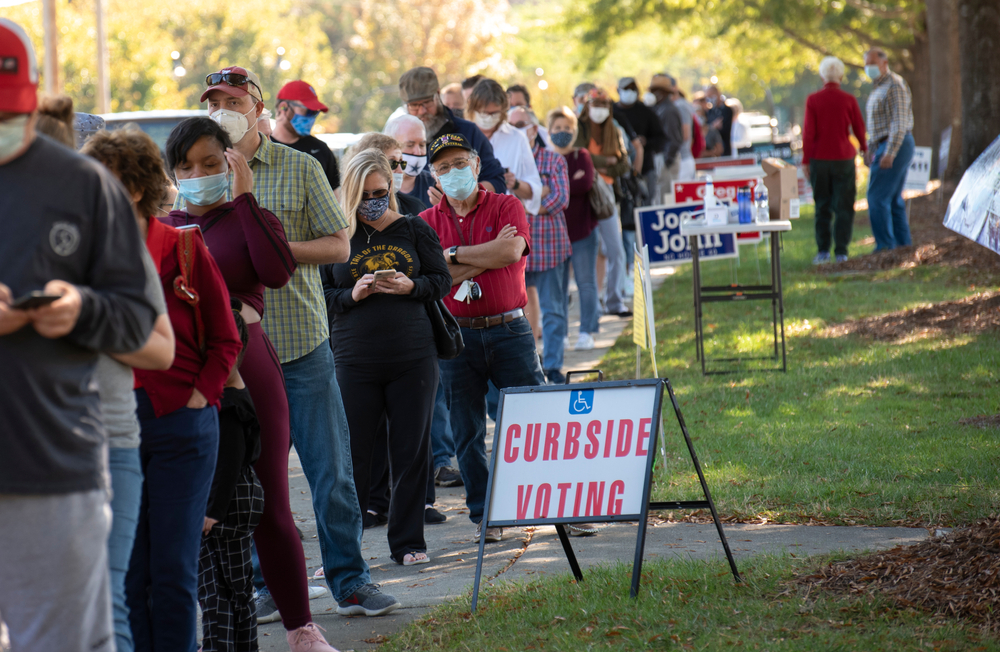
North Carolina is a firmly purple state, but you wouldn’t be able to tell from our congressional delegation. Despite regularly electing Democrats to statewide offices, Republicans dominate our House congressional races, with Cook predicting they will safely win 10 of our 14 House seats again in 2026.
Republicans’ electoral success isn’t because North Carolina voters strongly prefer Republican representatives, but because the Republican Party has drawn our House districts to ensure they win most of them through a process known as gerrymandering. Currently, aggrieved individuals, the NAACP, and Common Cause are suing over these maps; however, current precedents make it nearly impossible to get the maps discarded.
Both Speaker Destin Hall and Senate President Pro Tempore Phil Berger were named in suits (that eventually consolidated into Williams v. Hall) alleging the 2023 congressional, State House, and State Senate maps had illegally gerrymandered districts. The trial concluded on July 9th, featuring testimony from black community leaders about how the maps divided black communities across the state. The challenged maps will be used in the 2024 election regardless of the decision.
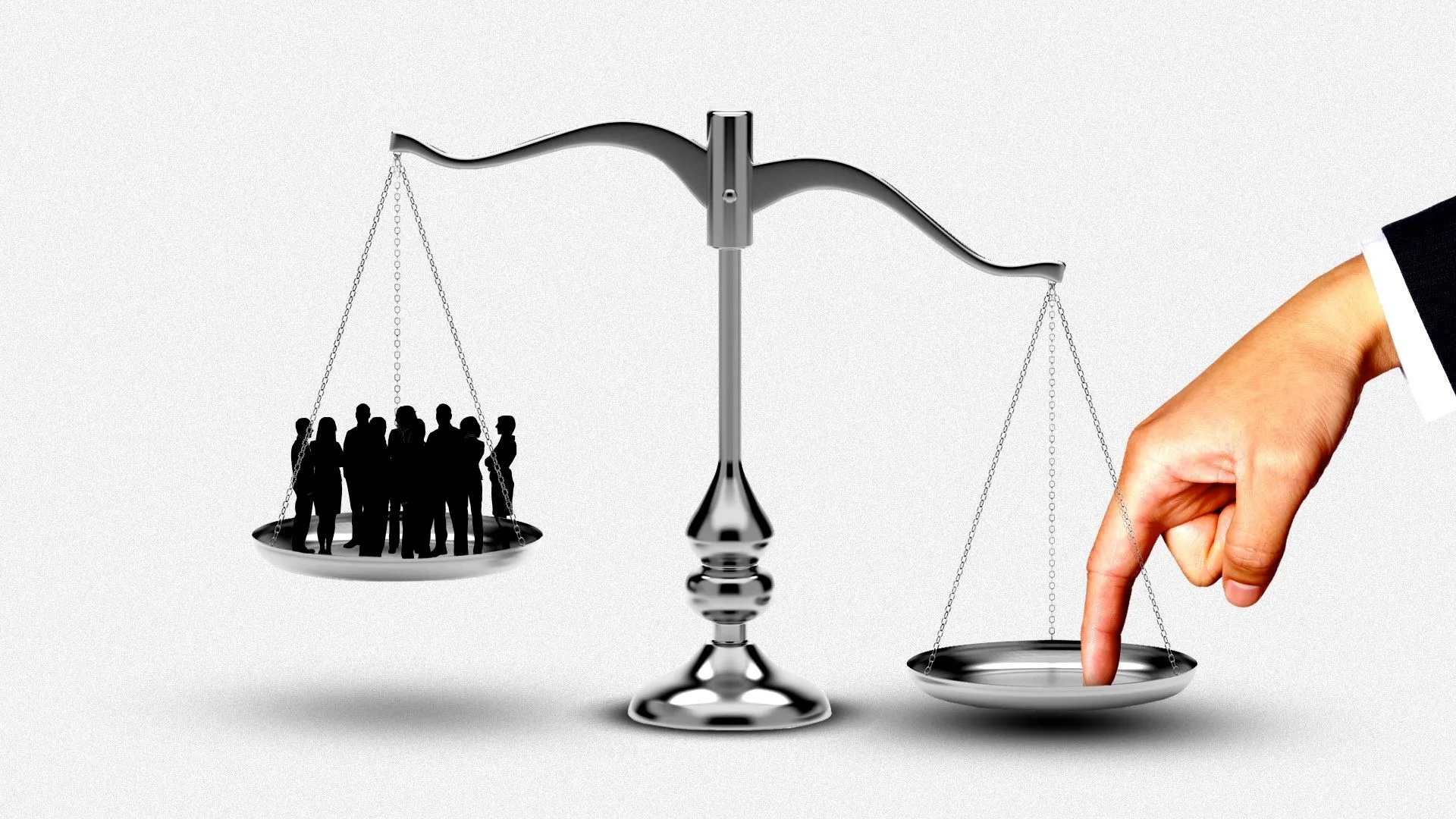
Gerrymandering is the intentional drawing of legislative district maps to influence the results of an election. In North Carolina, where the state legislature draws both its own districts and congressional districts, Republican legislators can (and do) draw districts that favor themselves and their party. North Carolina Republicans have a storied history of gerrymandering that we have discussed previously, including how it drives extremism and how Republicans gerrymandered the 2024 State House and Senate maps.
Gerrymandering contradicts the principles of a fair and democratic system. While there is no such thing as a perfectly fair map – every map will be biased towards the map drawer’s goals of keeping together municipalities, respecting cultural borders, conforming to natural geography, or political fairness – drawing palpably unfair maps is functionally a way to rig an election. However, due to recent court decisions from both SCOTUS and the North Carolina Supreme Court, it has become very challenging to get an unfair map overturned.
How We Got Here
In Rucho v. Common Cause, sparked in part by the infamous I-85-shaped District 12, the Supreme Court ruled that partisan gerrymandering is nonjusticiable – meaning the federal courts cannot hear claims about it – even though they acknowledged that excessive partisan gerrymandering was “incompatible with democratic principles.” For the court, addressing the issue was a political question; therefore, it was the job of Congress and the states. After Republicans took control of the North Carolina Supreme Court, they mirrored the reasoning in Rucho in Harper v. Hall as applied to our state constitution. Finding it “insightful and persuasive,” they decided that partisan gerrymandering was also a political question under state law and therefore nonjusticiable at the state level too.
As a result, partisan gerrymandering is completely nonjusticiable in North Carolina. However racial gerrymandering, drawing maps to reduce the voting power and representation of specific racial groups because of their race, can run afoul of the Voting Rights Act, the 14th Amendment, and the 15th Amendment. This is why the plaintiffs in Williams focused on proving that Republicans drew the maps with racially discriminatory, as opposed to partisan, intent.
Unfortunately, proving unconstitutional racial gerrymandering is incredibly difficult. The strategy of the defendants relies on the nonjusticiability of partisan gerrymandering by arguing in open court that the maps were drawn to give Republicans an advantage. Since federal law requires, as Justice Alito wrote for the majority of the court in Alexander v. South Carolina State Conference of the NAACP just last year, that “a party challenging a map’s constitutionality must disentangle race and politics if it wishes to prove that the legislature was motivated by race as opposed to partisanship” and that federal courts must “start with a presumption that the legislature acted in good faith” in these cases, arguing that a gerrymander is a legal partisan gerrymander instead of an illegal racial gerrymander is a viable defense.
These presumptions can be overcome “either through circumstantial evidence of a district’s shape and demographics or more direct evidence going to legislative purpose,” as the court said in Miller v. Johnson while building on Shaw v. Reno, but getting that evidence is incredibly difficult.
Gathering circumstantial evidence in an era of high racial polarization is nearly impossible. Even though Republicans in 2024 had a stronger-than-average showing with voters of color, over 80 percent of black voters voted for the Democratic presidential ticket. Unsurprisingly, the GOP’s consistent opposition to diversity initiatives, 98% white caucus in the General Assembly, and speeches on the house floor that the United States got a “bad rap” for slavery have alienated voters of color, but that alienation makes effectively racial gerrymanders perversely more viable.
As for direct evidence, map-drawing in North Carolina has been infamously secretive. Barring open testimony that a district was configured with race in mind – rare, but when lawmakers believe they are drawing a majority minority district to comply with the Voting Rights Act, plausible – getting that direct evidence is also nearly impossible.
The combination of racial polarization, those principles reinforced in Alexander, the federal non-justiciability of partisan gerrymandering from Rucho, and the state non-justiciability of partisan gerrymandering under Harper leaves us incredibly vulnerable to gerrymandering in North Carolina. Partisan gerrymandering is completely insulated from review by federal and state courts, barring direct evidence of racial predominance required to overcome the presumption or egregiously drawn districts, both of which featured in Cooper v. Harris. Maps that are, in actuality, well-drawn racial gerrymanders could potentially be passed off as partisan gerrymanders. However, regardless of whether the court in Williams strikes down or upholds the maps facing the current racial gerrymandering claim, the continued open existence of partisan gerrymanders is still an affront to democratic principles in North Carolina.
Where Do We Go
The combination of Harper, Alexander, and Rucho enables unlimited partisan gerrymandering in North Carolina and gives cover to racial gerrymanders. However, there are still avenues to fair maps.
Legislatively, North Carolina could copy other states in establishing independent redistricting commissions to draw fair maps. Unfortunately, this would require the Republican supermajority, a supermajority won partially through gerrymandering, to end gerrymandering, which is unlikely.
The North Carolina Constitution has its own equal protection clause in Article I, Section 19, and a free elections clause in Section 10. In theory, our state courts could interpret these clauses like the Federal Constitution’s equal protection clause, but without the same deferential presumptions from Shaw, Miller, and Alexander, making it easier to throw out racially gerrymandered maps. However, the success of this sort of litigation will depend on the composition of the court, and this strategy doesn’t cover pure partisan gerrymandering.
A faster, more direct, and more complete path to fair maps would be the North Carolina Supreme Court overturning Harper v. Hall and rendering partisan gerrymandering once again unconstitutional under our state constitution. When Democrats held a majority on the North Carolina Supreme Court in 2022, they ruled that partisan gerrymandering was unconstitutional under North Carolina’s Constitution. It took Republicans winning control of the court to overturn that decision the following year.
If Justice Anita Earls, who voted that partisan gerrymandering is unconstitutional under state law, holds her seat in 2026, and Democrats flip at least two seats in 2028, Harper v. Hall could be overturned. With that, North Carolina could be back on the path to fulfilling its constitutional obligations to free elections with equal protection under the law.