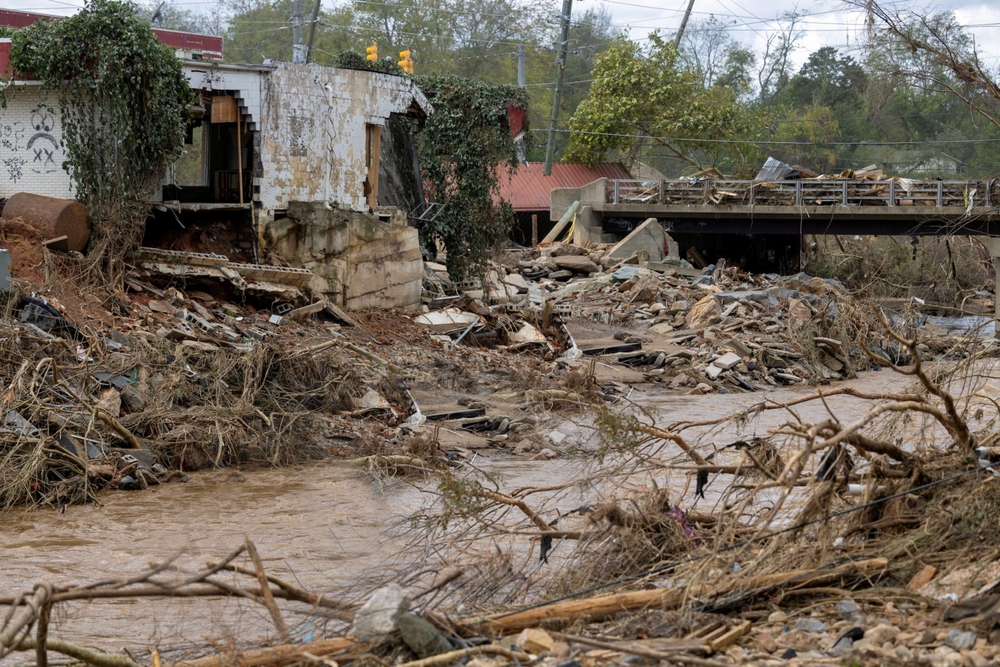
The damage Hurricane Helene inflicted on Western North Carolina last year borders on incalculable. The efforts of Western North Carolinians to rebuild during the past year stand among the greatest displays of resilience and courage in recent memory. Local residents led the recovery, supported by mutual aid networks and faith communities that provided critical assistance in the weeks and months after the storm. Despite this extraordinary work, the long-term recovery has become a source of frustration due to the lack of substantial federal support.
In September, Governor Stein requested both increased federal funding and the release of federal dollars already promised to Western North Carolina. His office outlined these concerns in a formal federal funding request, noting: “State and local governments and private corporations and charities are contributing billions collectively to this work, but their efforts alone cannot restore our communities.” The inadequate federal response reflects the consequences of disruptive federal reorganization and efforts by the Trump administration to limit support for Americans affected by disasters.
The Federal Response
The federal government traditionally plays a major role in helping communities rebuild after natural disasters. These recovery efforts often require more resources and expertise than local governments can provide. Disasters also affect multiple states, which creates a need for federal coordination. Hurricane Helene caused damage across ten states, underscoring this point.
FEMA, the Federal Emergency Management Agency, was created in 1979 to support communities before, during, and after disasters. Its mission is wide-ranging and demands sustained federal commitment. FEMA works alongside other agencies, including the Departments of Homeland Security, Housing and Urban Development, Transportation, Labor, Health and Human Services, and the EPA. The USDA has also outlined its role through its post-Helene recovery initiatives.
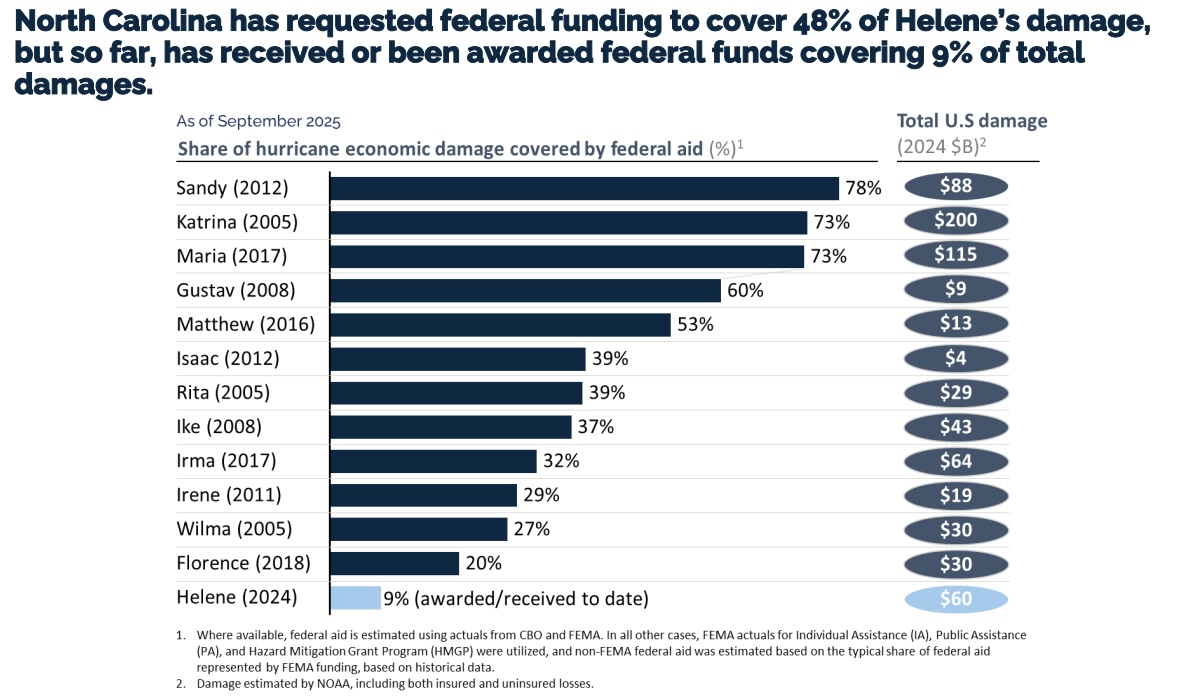
Historically, the federal government has provided significant financial support for major disasters. As Governor Stein noted, federal support covered 78% of the economic damage caused by Hurricane Sandy, 73% for Hurricanes Maria and Katrina, 60% for Gustav, and 53% for Matthew. Yet for Helene, the federal government has thus far covered only 9%.
Why Has the Government Been So Unhelpful?
Two major factors explain the lack of federal support.
The first is mismanagement. Instability within the Trump administration has directly affected FEMA. The agency is already on its third director this year, following the resignations of David Richardson and Karen Evans, both of whom were appointed without emergency management experience. Reporting in The New York Times examined Richardson’s troubled tenure and departure in detail through a review of FEMA leadership turmoil. His predecessor, Cameron Hamilton, was dismissed only a day after testifying to Congress that FEMA remained essential to communities in crisis, as documented in a separate news report.
This mismanagement aligns with a larger deliberate effort to weaken, eventually eliminate, FEMA. Trump and DHS Secretary Kristi Noem have both advocated for dismantling the agency. A broader analysis of this agenda, including its fiscal and humanitarian implications, appears in a Carnegie Endowment assessment of the administration’s push to abolish FEMA. The lack of federal support for Helene recovery is therefore not only a result of bureaucratic dysfunction but also part of a larger political project to withdraw the federal government from disaster response.
As FEMA resources to help rebuild the devastation in Western North Carolina have ground to a halt, the consequences have been noticed by political leaders in both parties. Just weeks ago, none other than Republican U.S. Senator Ted Budd blocked three Senate nominees submitted by President Donald Trump’s White House to demand action from FEMA. Specifically, Senator Budd asked the Department of Homeland Security (under which FEMA operates) to approve $64 million in reimbursements to North Carolina county governments, which are long overdue to be paid. Remarkably, DHS Secretary Kristi Noem released $12 million of those reimbursements the very same day following Senator Budd’s action.
This is good news for Western North Carolina (though we’re still waiting on the remaining $52 million). But what it also reveals is that a faster response is, in fact, entirely possible - those in charge in Washington simply aren’t doing it.
Consequences for Western North Carolina
Communities in Western North Carolina have felt these failures acutely. Disaster recovery leaders have repeatedly warned that federal delays are slowing progress. Avery County Commissioner Dennis Aldridge described FEMA as “our biggest obstacle,” a point highlighted in WRAL’s reporting. Avery County has already spent approximately $50 million on recovery and cleanup, despite having an annual operating budget of just $42 million. FEMA has agreed in principle to reimburse many of these expenses, but payments have been slow. Several news outlets have documented these delays, including WRAL’s coverage of counties pushed to their limits by slow FEMA reimbursements and The Washington Post’s analysis of stalled federal payments.
The recovery process is far from complete, and slow federal action only makes it harder for communities to rebuild. A federal government that restricts FEMA’s ability to operate effectively creates further harm. In response, Attorney General Jeff Jackson has filed suit against the federal government for withholding disaster relief funds, as reported by ABC11. A system that forces states to sue for congressionally approved disaster funds is deeply flawed.
Western North Carolina deserves a federal partner that will show up when disaster strikes. So do communities across the country. Anything less is its own form of disaster.