Following a growing national trend, the NC House introduced a bill in April 2025 that would study the state’s property tax reduction programs with a goal of reform. NC House Bill 432 would direct the Revenue Law Study Committee to evaluate options to decrease property taxes for low-income elderly and disabled residents and disabled veterans. The study bill passed the House with unanimous support before heading to the Senate. Once there, however, it stalled.
After months with no further progress on the bill, NC House Speaker Destin Hall formed the Select Committee on Property Tax Reduction and Reform in December.
Hall tasked the committee with considering the expansion of existing property tax exemptions, considering whether to alter how home revaluations work and also taking a look at how increased property taxes are impacting local government spending, including whether they are taking on higher levels of debt. (WUNC News)
Senator Berger has belatedly formed a parallel committee in the Senate as of Feb 4.
Factors Driving Home Prices
In their first meeting, on December 17th, the committee reviewed factors that influence home prices, the driving force behind rising property taxes. On the demand side, population growth, particularly the influx of retirees to NC, is outpacing new housing construction. The resulting competition for available homes is causing bidding wars and driving up prices. Low mortgage rates also contribute to demand.
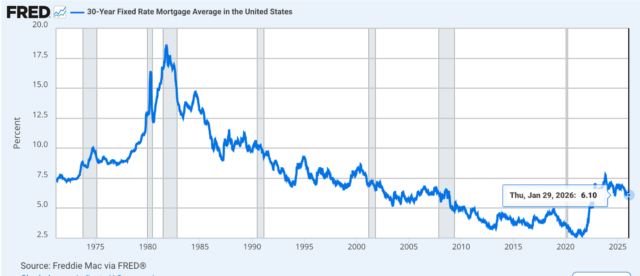
Although mortgage rates are now significantly higher than they were post-2008, they’re relatively close to the rate between 2000 and 2008, and lower than the rate between 1970 and 2000.
On the supply side, supply chain issues are continuing to drive up prices. The costs that go into creating housing break down into land, labor, materials, and money (interest on loans, either from banks, investors, or both). While the committee’s research specifically mentioned Covid-era supply chain disruptions, they omitted the impact of tariffs on materials and ICE activity on labor.
An April 2025 survey from the NAHB/Wells Fargo Housing Market Index estimates that recent tariffs could increase the cost of the average home by $10,900. That’s in addition to the 34% increase that has occurred since December 2020. According to the National Association of Homebuilders, the U.S. imported $14 billion of residential construction materials in 2024. That includes everything from Canadian lumber to steel, aluminum, and durable appliances imported from around the globe.
Likewise, immigration actions taken by ICE are driving up labor costs in the construction market. Approximately 1 in 3 U.S. construction workers is foreign-born. In NC alone, that equates to 60,000 people. Deportations are choking a labor market that is already short-handed, and the effect is not limited to undocumented immigrants. Even those here with work permits or green cards fear detention and are likely to avoid work when ICE is active in their area.
Combined, demand and supply side issues have resulted in NC housing prices that grew faster than the national average and, in 2024, reached 5 times median income.
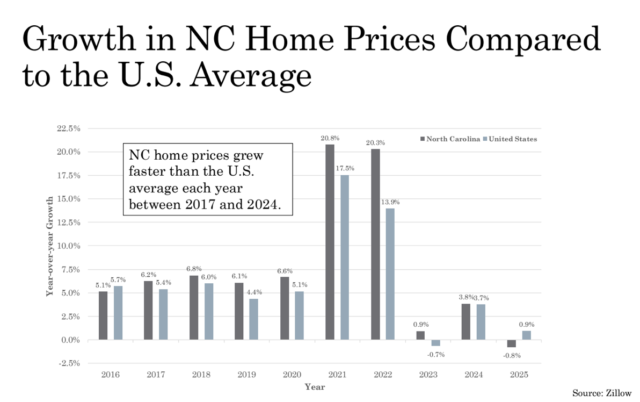
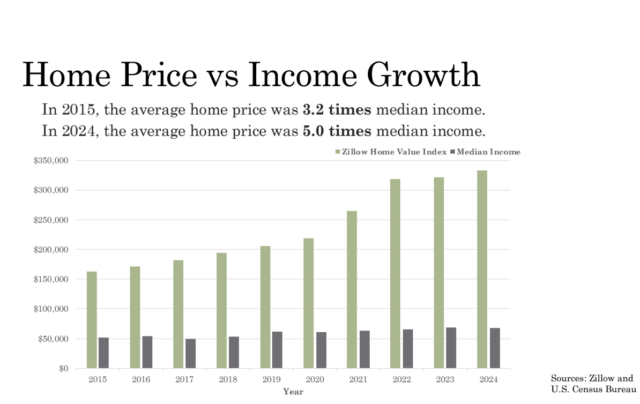
Unable or unwilling to act to reduce housing costs, which would directly address the underlying cause of rising property taxes, the committee is considering various means of capping property taxes themselves, even as housing prices continue to rise.
Current Law
Though property taxes are levied by local (municipal and county) governments, and the revenues fund local government budgets, the power to make laws defining and limiting property taxes is held by the state legislature and outlined in NC General Statute 105, Subchapter II (The Machinery Act). Under The Machinery Act, the General Assembly alone can determine exemptions from home property taxation. For 2026, the exemptions are:
- Elderly or Disabled Exclusion: Excludes 50% or the first $25,000, whichever is greater, of the appraised value of the home for homeowners who are at least 65 or permanently disabled and whose previous year’s income did not exceed $38,800.
- Disabled Veteran Exclusion: Excludes up to $45,000 of the appraised value of the permanent residence of a disabled veteran.
- Circuit Breaker Property Tax Deferment: Limits yearly taxes to a percentage of owner’s income in the previous year as long as the owner is 65 or older or totally and permanently disabled. Tax limits are 4% for qualified owners with incomes of $38,000 or less and 5% for qualified owners with incomes between $38,800 and $58,200. Taxes over the limitation amount are deferred and remain as a lien on the property that becomes payable with interest upon the death of the owner, the transfer of the property, or the failure by the owner to use the property as a permanent residence. A Circuit Breaker Deferment may not be used in conjunction with the other two exemptions.
What Comes Next?
In 2025, legislation to increase current exemptions for the elderly and the disabled was introduced. See the slide below from the presentation given at the December meeting of the Select Committee on Property Tax Reduction and Reform. While no specific policy actions have been finalized, revamping exemption rules to provide for new reductions seems a likely option, and the legislature may revisit some of these 2025 bills in part or in their entirety. Other options discussed include capping property tax rates, limiting assessment intervals, and amending the state constitution.
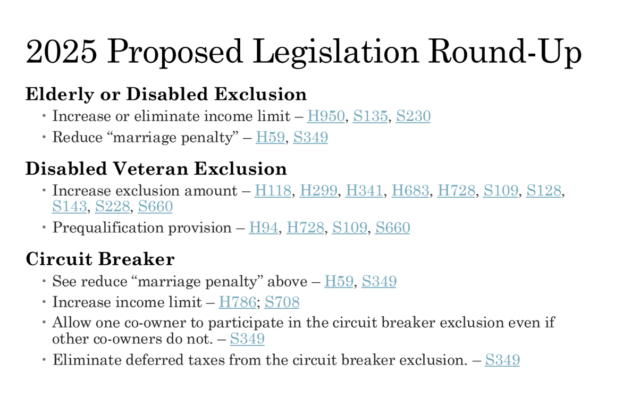
While there is bipartisan support for providing some form of additional property tax break to low-income seniors and disabled veterans, there is also concern about potential decreased revenues for local governments. Currently, NC’s personal income tax rate is 3.99% and scheduled to decrease to 2.49% by 2029. Meanwhile, the NC corporate tax rate sits at 2%, and is set to decrease to 0% by 2030. Lower tax revenue at the state level has resulted in reduced state funding of public schools. The state has already been sued for its failure to properly fund public schools. Simultaneously, funding from the federal government has been cancelled or delayed. Many local governments have attempted to supplement their education budgets by increasing property taxes. If property taxes are reduced or capped, then local governments would have no option but to cut services like schools, police, fire, parks, and trash collection.
One possibility that has been discussed is to limit exemptions for some nonprofits to offset decreased property taxes for seniors and disabled veterans. Could the local Elks Lodge contribute more to allow those groups to pay less and keep their homes? That’s one of many potential options to be discussed in the committee meetings that are scheduled to continue through the spring.
Coming to an agreement on property tax reform is just the first step, though. Even if the committee finalizes recommendations and the House adopts those recommendations, any legislation will need to receive the Senate’s approval. The lack of Senate response to House Bill 432 last spring does not inspire confidence.