
A recurring claim in debates over immigration policy is that undocumented immigrants “take jobs” from American workers and drive down wages. With North Carolina home to a substantial undocumented population, it’s worth examining the economic data to see whether the evidence supports this narrative.
The answer, based on all available data, is a clear No.
How many undocumented immigrants actually live in North Carolina?
Estimating the undocumented population is inherently imprecise, since by definition these individuals are not counted in official records. Different sources use varying methodologies, producing a range of estimates. Here are three independent calculations for North Carolina:
(See: Pew Research Center; Migration Policy Institute; America First Policy Institute; FAIR.)
Note: A higher share of undocumented immigrants are in the workforce than native-born Americans at large. For the purposes here, we assume 70% labor force participation among the undocumented population, consistent with research findings. North Carolina’s total workforce is approximately 5.1 million.
Pew Research Center is widely considered the most methodologically rigorous and politically neutral source for these estimates. But even taking the highest estimate from FAIR - a far-right organization identified by the Southern Poverty Law Center as an anti-immigrant hate group - undocumented workers would represent less than one in ten North Carolina workers.
Surveying the labor market
If undocumented immigrants were displacing American workers from jobs, we would logically expect to see evidence in North Carolina’s prime-age labor force participation rate. This metric measures the share of people in their peak working years (ages 24-54) who are either working or actively looking for work. When jobs become scarcer or less attractive due to competition, we would expect participation rates to fall as discouraged workers exit the labor market.
But this is not happening. In fact, North Carolina’s prime-age labor force participation rate has remained remarkably stable over the last two decades. The rate was 82.7% in 2024, compared to 82.6% in 2004.
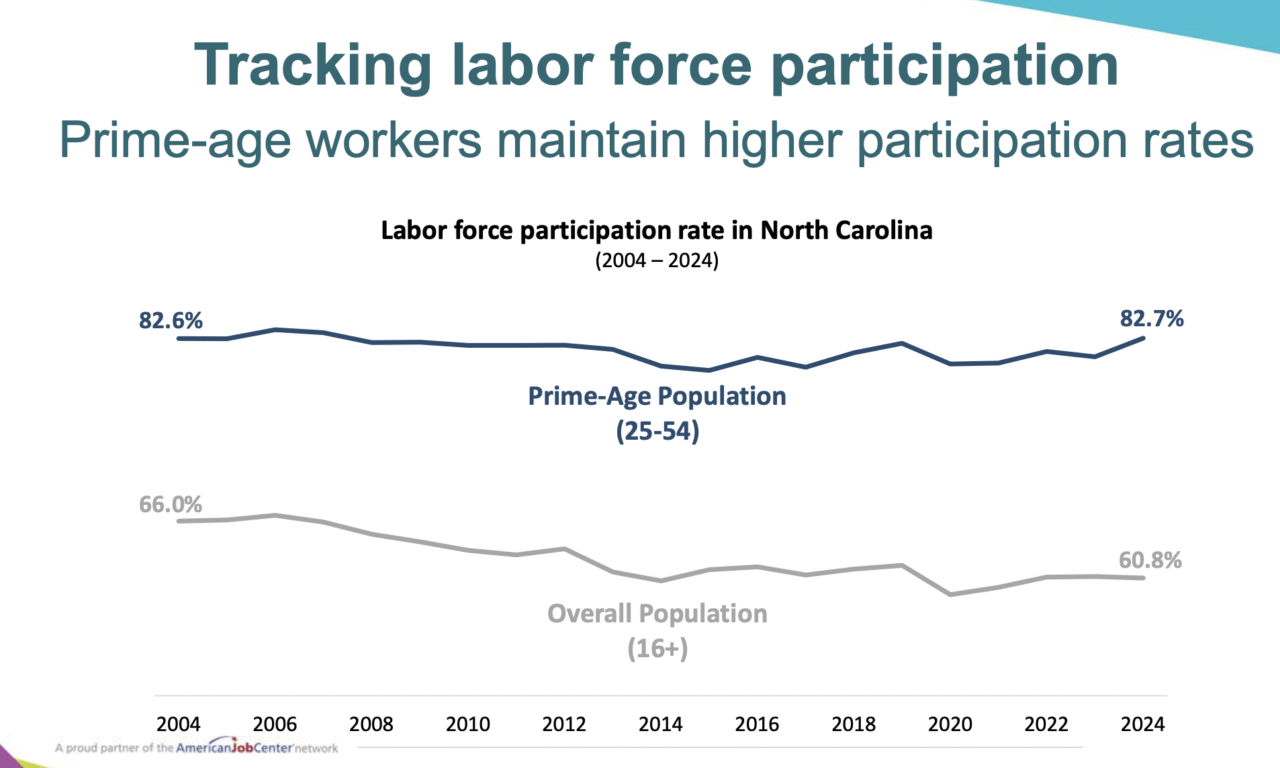
Source: NC Department of Commerce, U.S. Bureau of Labor Statistics
Prime-age workers are the most likely to compete with undocumented immigrants for jobs, and their story is one of remarkable labor market consistency - not displacement. If hundreds of thousands of undocumented workers were displacing jobs that would otherwise go to native-born North Carolinians, we would expect to see a corresponding decline in native-born workers’ employment. But this is nowhere to be found in the data.
Speaking of employment, North Carolina’s unemployment rate is currently 3.7%, close to a 20-year low. Once again, this is not consistent with immigrants (undocumented or otherwise) displacing other workers.
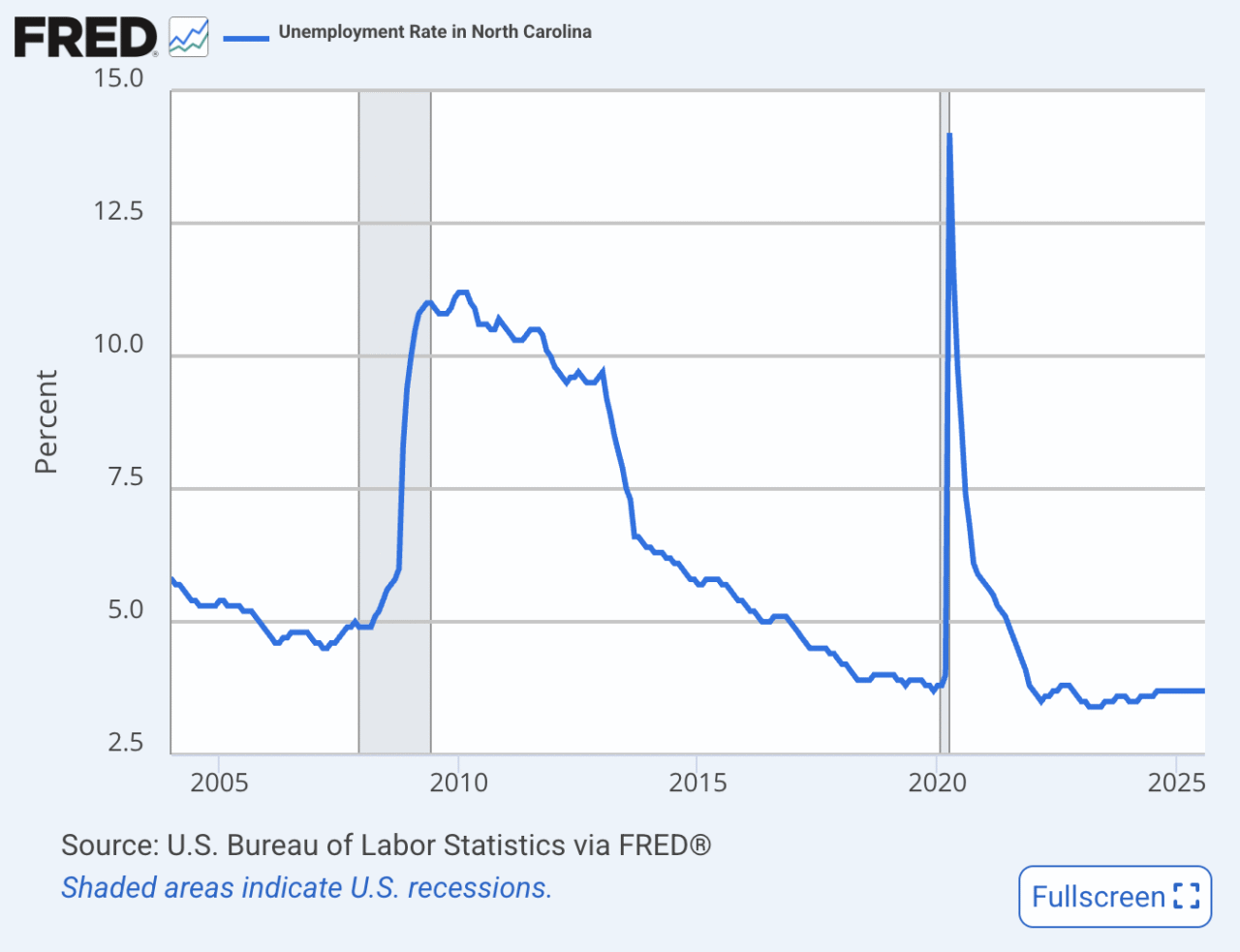
The timing of the decline in the unemployment rate matters. It coincides with the last year of the first Trump administration in 2020 during the COVID pandemic, and the Biden-Harris administration beginning in 2021, during which the United States saw a surge in immigration, as noted by Pew. Yet during this period of increase, the rate of unemployment in North Carolina also fell, weakening the argument that undocumented immigrants were displacing job opportunities.
The evidence on wage growth
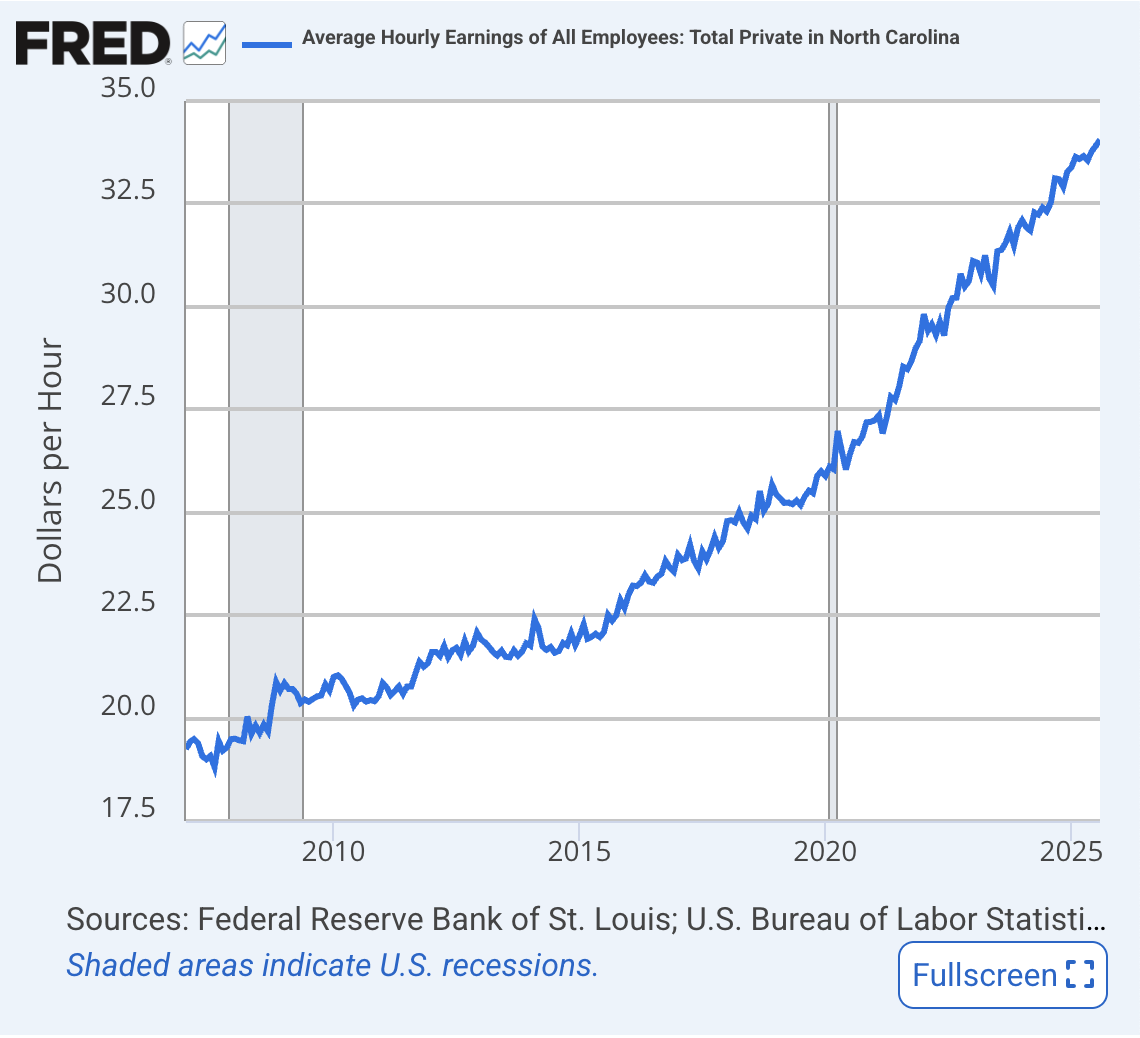
The second prediction of the “immigrants drive down wages” theory is straightforward: increased labor supply from undocumented workers might suppress wages, particularly in industries where they are most concentrated. But yet again, North Carolina’s wage data tells a different story.
Average hourly earnings across the state have consistently increased in North Carolina over time. During periods of increased immigration from 2020 to 2024, as mentioned above, wages actually rose faster than before.
Even if we drill down to a field like construction, an industry with substantial immigrant employment, average hourly earnings have consistently risen, not stagnated. Average hourly earnings in the construction field reached $36 per hour in August of 2025, continuing an upward trend that has persisted for years. Once again, those earnings increased more rapidly during periods of higher immigration.
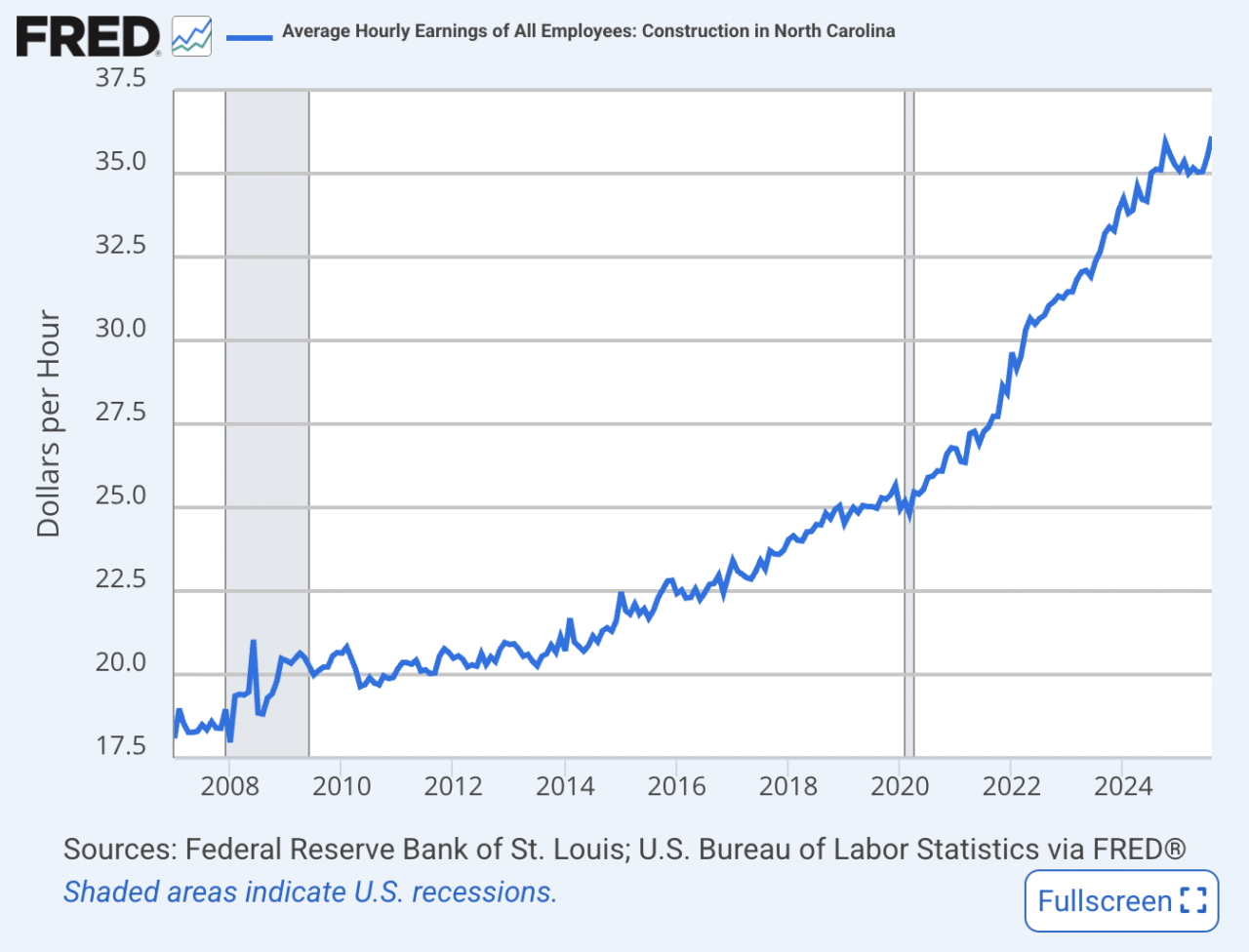
At the workforce level, there is simply no obvious evidence for wage depression caused by immigrant labor. If one looks carefully, the only clear evidence for downward wage pressure has occurred during economic recessions, when market demand falters.
What does the research say?
North Carolina’s experience aligns with the broader body of economic research on undocumented immigration and wages. While findings vary based on methodology and scope, a 2012 Brookings Institution review of the academic literature found immigrants do not cause sizable decreases in wages or employment of U.S.-born citizens, and instead may actually raise wages and lower prices in the aggregate. More recent research from 2024 and 2022 showed that moderate immigration had positive wage impacts for lower-educated workers, and that restricting access to low-skilled immigrant labor hurt firms’ economic output and reduced employment for native-born U.S. workers.
The key insight from economic research is that economies are not zero-sum; Immigrants do not simply “take” a static and fixed number of jobs. They also create new demand for goods and services, generate economic activity, start businesses, and fill labor market gaps. The net effect often depends on local conditions, but is more often positive than not.
Dodging the real problems
Is it nevertheless possible that high levels of immigration could theoretically have negative effects on jobs or wages under certain circumstances, or that all the data is wrong? Perhaps. But extraordinary claims require extraordinary evidence, and that evidence is nowhere to be seen in North Carolina’s economic data today.
More often than not, North Carolina’s actual experience is that of a labor shortage, not a surplus. From home construction to warehouses to daycares to farm labor, the difficulty of finding workers is right near the top of the business community’s biggest challenges.
North Carolina faces real economic challenges: an insufficient housing supply, stagnant rural economies, and a dysfunctional state legislature, just to name a few. Undocumented immigrants are not responsible for these problems, but also do not vote, which make them a convenient scapegoat for unscrupulous political leaders looking to dodge responsibility.