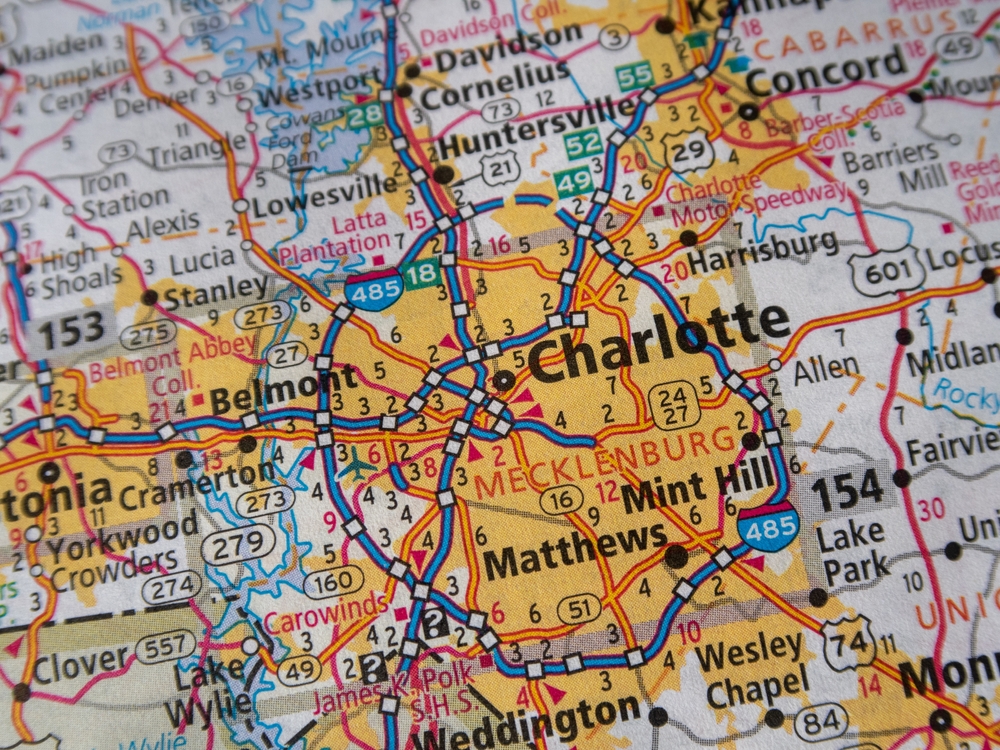
For nearly a decade, Charlotte and north Mecklenburg have lived with the consequences of the I‑77 express toll lanes: unpredictable toll prices, community anger, and a transportation system that prioritizes profit over people. Now, as the new I-485 express lanes open in south Charlotte, the North Carolina Department of Transportation (NCDOT) wants to double down by extending those toll lanes from Uptown Charlotte to the South Carolina line, effectively connecting the two existing express lane routes. If this sounds familiar, it’s because we’ve been here before, and the results were deeply harmful.
The latest chapter in this saga reveals a troubling pattern: limited transparency, misleading assurances to elected officials, and real harm to historically marginalized communities. Charlotte and Mecklenburg County deserve better.
That’s why last week, Carolina Forward signed onto a letter outlining why the I-77 expansion project must be paused. You too can tell decision makers that you want to pause the project by signing the petition.
A Process Designed to Box Communities Out
In October 2024, the Charlotte City Council was asked to support NCDOT’s plan to pursue a public‑private partnership for the I‑77 toll lane extension. Council members were assured this was merely a procedural step and that there would be ample opportunity to say no later.
The approval allowed Charlotte’s representative to the Charlotte Regional Transportation Planning Organization (CRTPO), the federally mandated Metropolitan Planning Organization (MPO) for the Charlotte Urban Area, to vote in favor of the project with language stating CRTPO could only withdraw its support until NCDOT issued a Request for Qualifications (RFQ). While an RFQ is not a full construction contract, it has been treated by the state as a point of no return, effectively locking in the project before the public ever saw the full impacts.
NCDOT issued that RFQ in August 2025. Only after that deadline passed did the department release detailed maps showing what the project would actually look like.
That timing matters.
At an October 2024 council meeting, NCDOT officials acknowledged they already had “preliminary design concepts” but chose not to share them publicly because, in their words, there was not yet a “clear path forward.” By the time the path was clear, the public’s ability to meaningfully intervene had vanished.
This is the opposite of transparent, community‑centered planning. It is a textbook example of a bait‑and‑switch.
Environmental Justice on the Line
When the maps were finally released in fall 2025, West Charlotte residents were rightly outraged.
Some proposed alignments would demolish homes. Others would cut into Frazier Park and Pinewood Cemetery, a historic Black burial ground. Elevated toll lanes would bring increased noise pollution and visual blight to neighborhoods that have already borne the brunt of past highway construction.
This is not theoretical harm. It follows a long and painful pattern in North Carolina and across the South, where highway projects were deliberately routed through Black neighborhoods, destroying generational wealth and community cohesion in the name of “progress.” The federal government has repeatedly acknowledged this history, including through its focus on environmental justice in transportation planning.
Furthermore, Charlotte should not repeat these mistakes.
Toll Roads, Induced Demand, and Equity Impacts
A central justification for the I-77 South toll lane extension is congestion relief. However, decades of transportation research suggest that adding highway capacity rarely delivers lasting congestion reduction due to a well-documented phenomenon known as induced demand.
The Federal Highway Administration (FHWA) defines induced demand as the increase in vehicle travel that occurs when roadway capacity is expanded, noting that “additional capacity tends to generate additional travel over time.” Empirical studies reviewed by the National Academies of Sciences, Engineering, and Medicine similarly conclude that lane additions are often followed by proportional increases in vehicle miles traveled, eroding short-term congestion benefits.
Express toll lanes introduce additional equity considerations. The US Department of Transportation has acknowledged that tolling and congestion pricing can disproportionately affect lower-income households when not paired with viable transit alternatives or mitigation strategies. FHWA research further indicates that priced lanes may result in unequal access to travel time savings, favoring higher-income drivers.
The Role of the State Transportation Improvement Program (STIP)
The I-77 South toll lane project is advancing through North Carolina’s State Transportation Improvement Program (STIP). This federally mandated 10-year planning document identifies funding sources, construction schedules, and project priorities statewide. Inclusion in the STIP is required for projects seeking federal transportation funding and signals intent to move toward construction.
Metropolitan planning organizations such as CRTPO play a key role in determining which projects enter and remain in the STIP. Federal guidance allows amendments or removals when projects face unresolved local opposition or compliance concerns.
This framework underscores why CRTPO’s authority matters: withdrawal of regional support could affect the project’s STIP status, funding timeline, and advancement toward construction.
Local Democracy vs. State Power
As public opposition has grown, local leaders have begun asking an obvious question: Can this project still be stopped?
There is precedent for CRTPO to remove projects from the state’s Transportation Improvement Program, including a road-widening project in Matthews that local officials opposed. Yet many CRTPO members now claim they don’t know whether they have the authority to halt or pause the I‑77 extension, even though the board’s own chair has suggested the deadline may not be legally binding.
That uncertainty speaks volumes. Local governments are being told they have a voice, only to discover that when they try to use it, real power lies elsewhere.
Ultimately, NCDOT answers to the Governor. That means the final responsibility does not rest with a regional planning body or a single council committee it rests with Governor Josh Stein.
Importantly, new legal analysis undercuts the claim that local officials are powerless to act. In a letter to the Charlotte Regional Transportation Planning Organization (CRTPO), Megan Kimball, senior attorney at the Southern Environmental Law Center, concluded that CRTPO retains continuing authority to reconsider and withdraw its prior support for the I‑77 South toll project. According to Kimball, neither the issuance of a Request for Qualifications nor the wording of CRTPO’s October 2024 vote creates “vested rights” that would lock the project in place.
In other words, the so‑called point of no return may not exist at all.
CRTPO leadership has acknowledged receiving the memo and says its own attorney is still reviewing the issue, at the urging of Mecklenburg County Commissioner Leigh Altman. The Charlotte City Council is also expected to discuss its options at an upcoming retreat. While no single city can stop the project alone, the regional body that requested it may still have the legal authority and responsibility to pull it back.
History offers a clear warning. Former Governor Pat McCrory’s embrace of I‑77 toll lanes became a political liability that he believes contributed to his 2016 defeat. Voters remember when their concerns are ignored.
A Better Path Forward
Charlotte is growing. We need transportation solutions that are equitable, transparent, and aligned with our climate and housing goals.
That means:
- Pausing the I‑77 toll lane extension until communities have full information and real decision‑making power.
- Redirecting investment toward transit, multimodal infrastructure, and demand‑reduction strategies that actually work.
- Committing to environmental justice so that Black and brown neighborhoods are no longer treated as expendable.
The question is no longer whether the I‑77 toll lane extension is controversial. The question is whether state leaders are willing to listen.
What This Means Right Now
Despite repeated claims that it is “too late” to change course, recent legal analysis and precedent make clear that the I-77 South toll lane project is not inevitable.
Local opposition is growing and increasingly unified. A majority of the Mecklenburg County Board of Commissioners has already voted against the toll lane vision, and Charlotte City Council members have publicly expressed support for pausing the project while its impacts are reassessed.
Finally, time still matters. While an RFQ has been issued, no final construction contract has been awarded. Once a contract is executed, the legal and financial barriers to stopping the project increase dramatically.
The takeaway is simple: claims that communities have “missed their chance” are not grounded in law or precedent. Regional leaders still have tools available to pause or stop this project, but only if they choose to use them.
Charlotte deserves a transportation system that serves people, not private profit margins.